October 6, 2026
What Is a Good Online Quran Academy for Children in the UK?
Open this article to continue reading more insights.


Learning to read the Quran as an adult can be deeply rewarding, but it can also reveal reading habits that have developed over many years. Some adults learned Arabic letters as children but never studied Tajweed in detail. Others can recognize Quranic words yet struggle with pronunciation, fluency, stopping points, or similar-sounding Arabic letters.
The good news is that Quran reading can improve at any age.
Many of the common Quran reading mistakes adults make are not caused by a lack of effort. They usually come from an incomplete foundation, limited feedback, or repeatedly reading without someone identifying the exact mistake.
At International Quran Academy, adult learners can strengthen their reading through structured practice, qualified teachers, and courses designed to develop pronunciation, fluency, and Tajweed step by step.
If you already read the Quran but want to improve accuracy, the academy's Quran Reading Course provides a useful starting point. Adults who need more detailed pronunciation and Tajweed correction can also study through the Online Tajweed Course.
Adults often approach Quran reading differently from children.
A child may start from the Arabic alphabet and build each skill gradually. An adult may already recognize many words and therefore try to move directly into fluent recitation.
That can sometimes hide weaknesses in the foundation.
For example, a learner may recognize the letter ع when seeing it on the page but still pronounce it too closely to ا or ء. Another reader may understand that ص and س are different letters but pronounce both with almost the same sound.
Because the reader already knows what the word says, the brain may automatically fill in the pronunciation instead of noticing the mistake.
This is one reason live correction is valuable. A qualified Quran teacher can hear errors that the learner may not recognize independently.
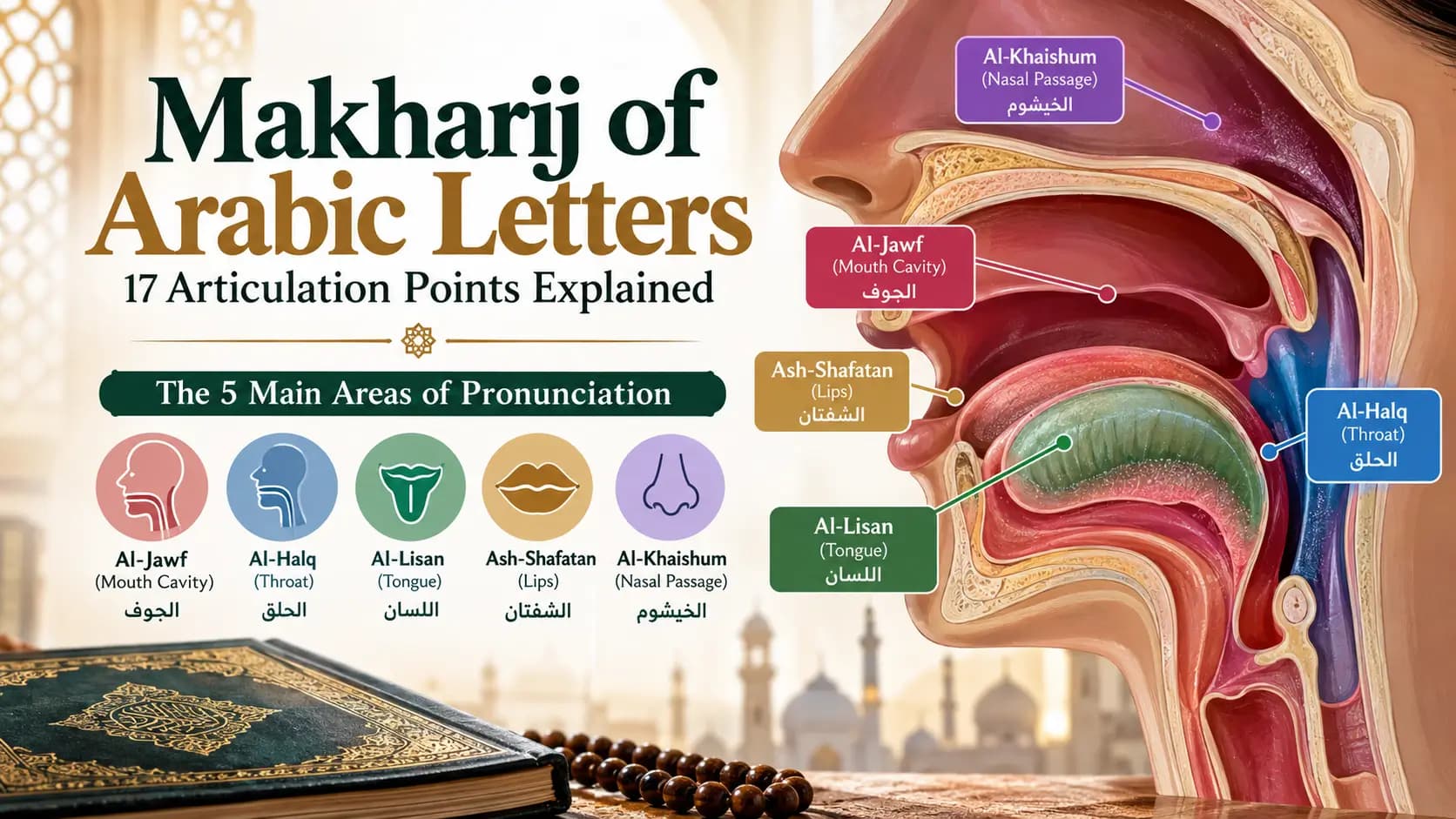
One of the most common Quran reading mistakes among adults is incorrect Makharij, or articulation points.
Every Arabic letter has a specific place from which its sound is produced. Some letters originate from the throat, others involve particular areas of the tongue, while some are formed using the lips.
When the articulation point changes, one Arabic letter may begin to sound like another.
Common examples include confusing:
س and ص, ت and ط, د and ض, ك and ق, ه and ح, ا/ء and ع, or ز, ذ and ظ.
These differences can be difficult for non-Arabic speakers because their first language may not contain the same sounds.
The solution is not simply to read the same word faster.
Slow down and isolate the difficult letter. Listen to the teacher demonstrate it, observe the position of the tongue or throat, repeat the sound separately, and then place it back into the Quranic word.
Adults who need to rebuild these fundamentals can also revisit the academy's Noorani Qaida Course. Returning to basic pronunciation is not going backwards; sometimes it is the fastest way to correct long-standing reading habits.
Some Quranic letters naturally have a heavier quality, while others are read more lightly.
Adults who learned primarily through transliteration or informal instruction may recognize the letters correctly but fail to give them their proper characteristics.
For example, ص should not sound exactly like س, and ط should not sound exactly like ت.
Similarly, the pronunciation of ر and ل can change according to specific Tajweed conditions.
These differences are part of what makes Quranic Arabic precise.
A useful practice is to compare similar letters side by side rather than practicing them separately. Hearing and repeating س / ص, ت / ط, or ك / ق makes the contrast easier to recognize.
The academy's Tajweed Course specifically develops correct articulation and the characteristics of Quranic letters for beginner, intermediate, and advanced learners.
Fluency does not mean speed.
Some adults try to recite quickly because they believe smooth reading is the same as fast reading. This can cause letters to disappear, vowel sounds to become unclear, Tajweed rules to be skipped, and stopping points to be ignored.
A slower recitation with correct pronunciation is more useful for improvement than a fast recitation containing repeated errors.
When correcting your reading, deliberately reduce your speed.
Give every letter its full sound. Notice the vowel marks. Allow Madd where required. Apply Ghunnah correctly. Complete the word before moving to the next one.
Speed can develop later as accuracy becomes natural.
If your main problem is fluency rather than recognizing letters, the Quran Recitation Course is a more relevant next step than starting from the alphabet again.
Another frequent problem is making vowels too short or extending them longer than required.
In Quran recitation, the length of a sound matters.
An adult learner may see an Alif, Waw, or Ya and automatically extend every sound in the same way. Others do the opposite and rush through places where elongation is required.
The correction begins with learning the basic forms of Madd and recognizing that not every long vowel is treated identically.
Instead of guessing the duration, practice with a teacher who can demonstrate the sound and ask you to repeat it.
Counting the required beats during practice can also help until the correct length becomes natural.
The Shaddah indicates that a letter is effectively doubled in pronunciation.
When adults read quickly, they sometimes pass over the Shaddah as if the letter appeared only once.
That changes the way the word is pronounced and can make recitation inaccurate.
When you see a Shaddah, consciously give the letter its proper emphasis.
For beginners and returning readers, it can help to mark or mentally identify every Shaddah before reading the verse aloud.
Over time, this becomes automatic.
Ghunnah is the nasal sound associated with particular Tajweed situations, especially with ن and م.
Some readers omit the nasal quality completely. Others exaggerate it so much that the recitation becomes unnatural.
Correct Ghunnah requires balance.
The sound should be clear without becoming forced.
Because this is difficult to assess by yourself, listening and repeating after a qualified teacher is particularly helpful.
The academy's Tajweed curriculum includes rules involving Noon Sakin, Tanween, and Meem Sakin, all of which are important for developing accurate application of these sounds.
Qalqalah occurs with particular letters when they appear in a state of Sukoon.
A common mistake is either reading the letter too softly so that the Qalqalah disappears, or adding a full vowel sound that is not actually there.
The goal is a controlled echo or bounce—not the addition of an extra Fatḥah, Kasrah, or Dammah.
For example, a learner should not turn a Qalqalah sound into an entirely new syllable.
Practice the Qalqalah letters individually first and then practice them inside words and at stopping positions.
This problem deserves special attention because it is extremely common among adult non-Arabic speakers.
Letters such as ث, س, ص, ذ, ز, ظ, ح, ه, ع, ء, and ق, ك can become difficult when the reader's native language does not contain equivalent sounds.
The mistake often becomes habitual because the learner has been pronouncing the letter in the same way for years.
Correction requires more than hearing the correct sound once.
You need repeated contrast practice.
Listen to both letters. Produce them separately. Read simple words containing each letter. Then apply the distinction while reading Quran.
The academy's online Noorani Qaida with Tajweed guide can also be useful for revisiting Arabic sounds and foundational letter groups before moving into longer recitation passages.
Noon Sakin and Tanween are governed by different Tajweed rules depending on the letter that follows.
Adults who have learned Quran primarily through visual reading may pronounce every Noon or Tanween in the same way.
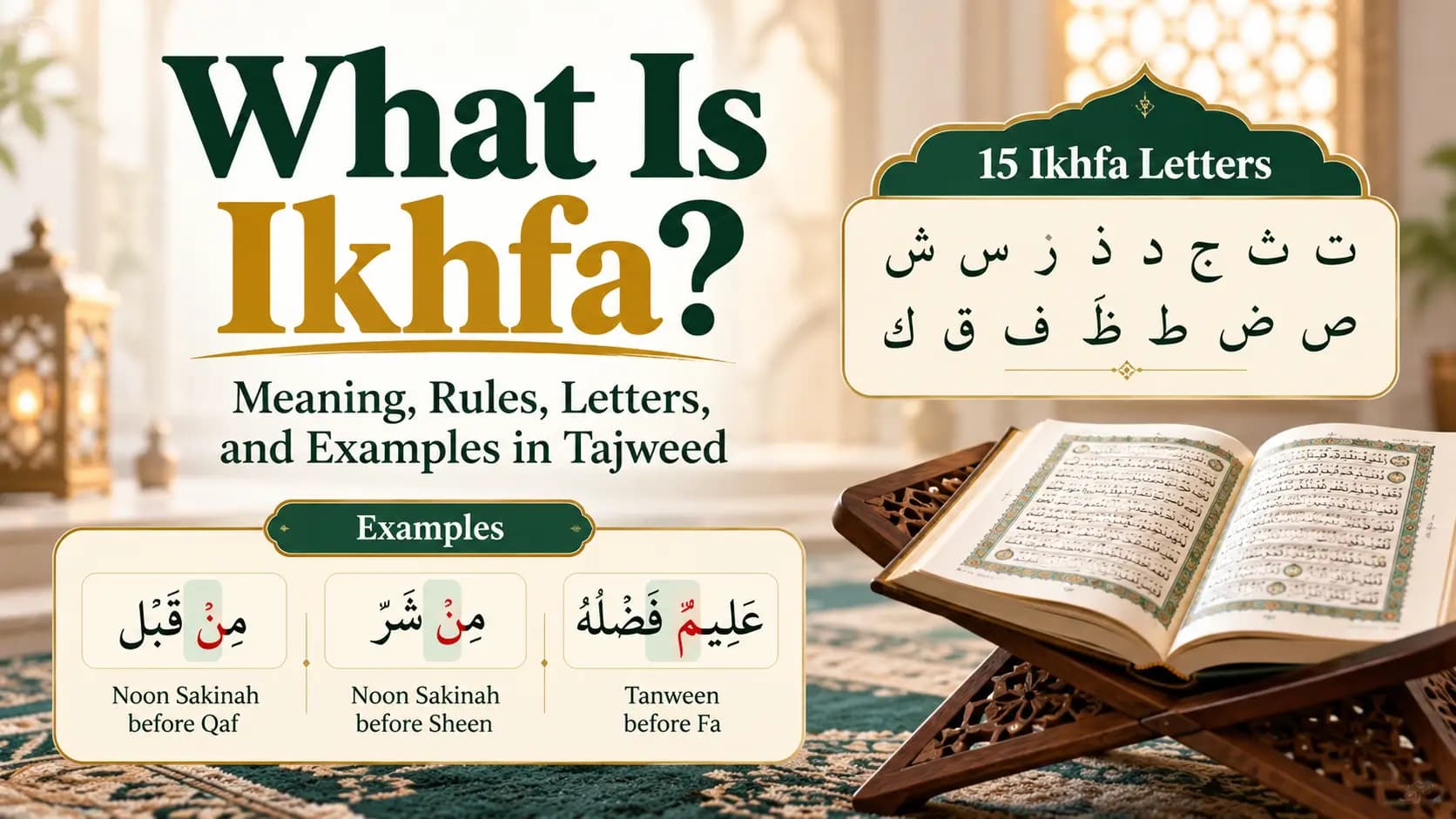
However, recitation changes according to rules such as Izhar, Idgham, Iqlab, and Ikhfa.
Trying to memorize every rule at once can feel overwhelming.
A better approach is to learn one category, practice several Quranic examples, and then move to the next.
The objective is not simply to remember the name “Ikhfa.” The real goal is to recognize it while reading and apply it correctly without interrupting the flow of recitation.
Knowing where to stop and where to continue is an important part of Quran recitation.
Some adults stop simply because they run out of breath.
Others continue reading through a place where pausing would be more appropriate.
Stopping incorrectly can disrupt the meaning or make the recitation sound unnatural.
Pay attention to the Quran's stopping signs and gradually learn what the common symbols indicate.
Breath control also improves with practice, so there is no need to force yourself through an entire long verse if doing so causes pronunciation to deteriorate.
Advanced students who want to develop more refined Quran recitation can later explore areas such as Tajweed and Qira'at through the academy's broader recitation programs.
Stopping correctly is only half the issue.
A reader must also know how to resume appropriately.
If you pause in the middle of a long verse because of breath, restarting from the exact next word may sometimes create an incomplete or confusing meaning.
A teacher can help you identify an appropriate phrase from which to resume.
This skill becomes increasingly important as a learner progresses from basic reading to more confident recitation.
English transliteration can help complete beginners recognize words, but relying on it for too long can limit pronunciation.
English letters cannot reproduce every Arabic sound accurately.
For example, writing several different Arabic letters using similar English spellings can hide the real distinctions between their Makharij.
Adults who want to read the Quran confidently should gradually move away from transliteration and learn directly from the Arabic script.
If Arabic-letter recognition itself remains difficult, a structured foundation such as the Noorani Qaida Course can help rebuild those skills.
One of the biggest mistakes is assuming that repeated reading automatically fixes pronunciation.
Practice strengthens whatever you repeatedly do.
If the pronunciation is correct, repetition strengthens correct reading.
If the pronunciation is wrong, repetition can strengthen the mistake.
This is why feedback matters.
Record yourself occasionally, listen carefully, and compare your reading with a qualified reciter. More importantly, work with a teacher who can stop you at the exact point where an error occurs.
International Quran Academy provides live Quran teaching with qualified instructors, and learners can view available Quran teachers before choosing a suitable learning path. The academy currently offers both male and female tutors and personalized online instruction.
This may not be a pronunciation error, but it prevents many Quran-reading mistakes from ever being corrected.
Adults sometimes feel embarrassed to return to Qaida or admit that they struggle with basic letters.
There is no reason to feel that way.
Someone may have read Quran for twenty years and still never have had the opportunity to study Tajweed with a teacher who could correct them individually.
Identifying a weakness is the beginning of improvement.
A learner who returns to a foundational lesson for several weeks may ultimately progress faster than someone who continues reading the same way for several more years.
Improvement works best when it is systematic.
Start by asking a teacher to identify your most frequent errors rather than trying to fix everything simultaneously. For example, if your main problem is confusing ق and ك, focus specifically on those sounds for several days.
Then apply the corrected sound in short Quranic passages.
Record yourself from time to time so you can hear your own progress.
Practice regularly, even if each session is short.
Most importantly, read slowly enough to notice the rules you are trying to apply.
Adults who want structured support can begin with the academy's Quran Reading Course or move into the Online Tajweed Course if they already have a good reading foundation.
This depends on your current level.
If you struggle to recognize Arabic letters, join letters, understand vowel signs, or read basic words, start with Quran-reading foundations or Noorani Qaida.
If you can already read Quran but regularly make pronunciation, Makharij, Madd, Ghunnah, or stopping mistakes, a Tajweed-focused course is likely more appropriate.
If you read accurately but want greater fluency and refinement, Quran recitation training may be the better next step.
International Quran Academy's existing courses cover all three stages: Noorani Qaida, Quran Reading, and Tajweed. The academy describes its Tajweed program as suitable for beginner, intermediate, and advanced students.
Yes. Adults may have gaps in pronunciation, Tajweed, fluency, or foundational Arabic reading. What matters is identifying those errors and working consistently to correct them.
Incorrect Makharij is one of the most important recurring problems because pronouncing a letter from the wrong articulation point can make it sound like another Arabic letter.
Yes. Adults can improve pronunciation, Tajweed, fluency, and confidence through regular practice and corrective feedback.
Not everyone does. However, if you regularly confuse Arabic letters or struggle with vowels and joining words, revisiting selected Qaida lessons may be very useful.
Yes. Live online Tajweed classes allow a teacher to listen to your recitation, identify mistakes, demonstrate correct pronunciation, and ask you to repeat difficult sounds.
Regular short practice is usually more useful than occasional long sessions. Consistency gives you more opportunities to reinforce correct pronunciation.
No. Accuracy should come first. Speed usually improves naturally once correct reading becomes familiar.
The common Quran reading mistakes adults make—incorrect Makharij, confusing similar letters, weak Tajweed application, wrong Madd, missed Shaddah, stopping incorrectly, and reading too quickly—are all skills that can improve with focused practice.
You do not need to correct everything in one day.
Identify one weakness. Learn the correct method. Practice it slowly. Receive feedback. Then move to the next area.
Over time, small corrections can transform the clarity and confidence of your Quran recitation.
If you would like a teacher to assess your current reading and identify the areas that need improvement, you can start with a free trial Quran class at International Quran Academy. The academy currently offers online Quran Reading and Tajweed instruction with flexible scheduling for adult learners as well as children.