
If you are starting to learn the Quran as an adult, one of your first questions may be:
How long does it take an adult to learn Quran?
For many adults, developing a solid foundation in Quran reading may take around 6 to 8 months of consistent study, although there is no fixed timeline that applies to everyone.
Some adults learn to recognize Arabic letters and begin reading simple Quranic words within a few months. Others need longer, especially if they are starting with no knowledge of Arabic or can only attend classes once or twice a week.
Your timeline also depends on what you mean by "learn Quran."
Learning to recognize Arabic letters is very different from becoming a fluent Quran reader. Reading fluently is different from mastering Tajweed, understanding Quranic Arabic, or memorizing the entire Quran.
The better question is therefore:
What do you want to achieve, and how consistently can you study?
This guide explains realistic learning stages for adults, what affects your progress, and how you can learn the Quran more effectively without putting unnecessary pressure on yourself.
Quick Answer: How Long Does It Take to Learn Quran as an Adult?
Here is a practical way to think about the learning journey.
| Learning Goal | General Learning Time |
|---|---|
| Learn Arabic letters and basic sounds | Around 1–3 months |
| Build basic Qaida reading skills | Around 2–4 months |
| Learn to read Quran from the beginning | Around 6–8 months for many consistent learners |
| Improve Quran reading fluency | Several additional months of regular practice |
| Learn Tajweed properly | Around 4–6 months for many students with reading ability |
| Build foundational Quranic Arabic skills | Around 1 year of structured study |
| Memorize the complete Quran | Often 2 years or longer with intensive, consistent study |
These are guidelines, not guarantees.
An adult studying five days per week with a teacher will usually progress differently from someone practicing once a week. Previous Arabic knowledge, lesson quality, age, pronunciation ability, revision, and practice outside class can all affect the result.
First, Define What "Learning the Quran" Means to You
Two adults can both say, "I want to learn Quran," while having completely different goals.
One may mean:
"I cannot recognize Arabic letters and want to learn how to read."
Another may already read but want to correct pronunciation.
Another may want to understand the Quran in Arabic.
Another may want to memorize it.
Before thinking about how many months the journey will take, identify your goal.
Common goals include:
- Learning Arabic letters
- Completing Noorani Qaida
- Reading Quran independently
- Improving Nazra fluency
- Correcting Makharij
- Learning Tajweed
- Memorizing Surahs
- Completing Hifz
- Understanding Quran translation
- Studying Tafseer
- Learning Quranic Arabic
Each goal requires a different learning plan.
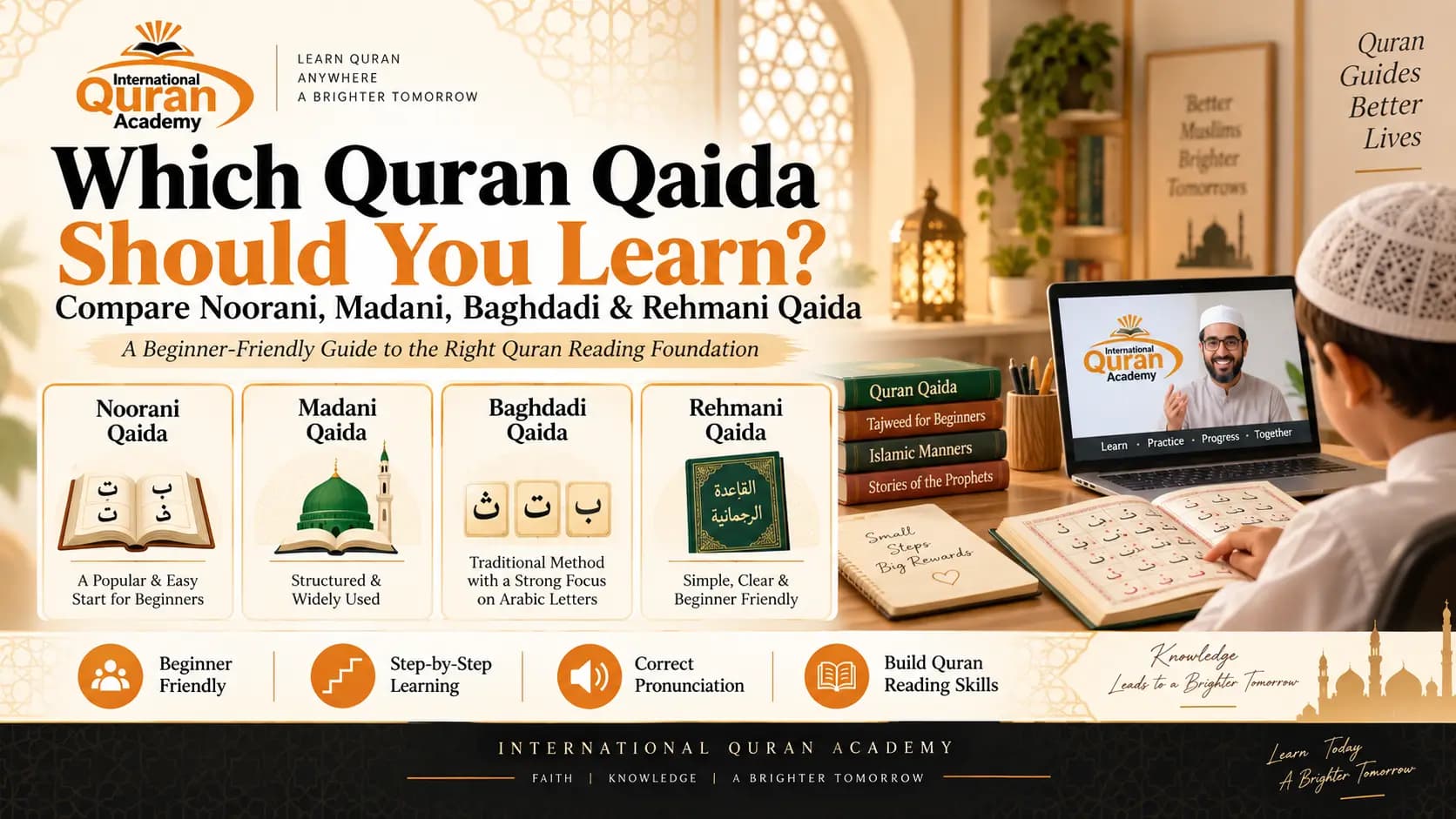
If you are a complete beginner, International Quran Academy's Noorani Qaida Course can help you begin with Arabic letters, pronunciation, and foundational reading before progressing to full Quran recitation.
How Long Does It Take a Complete Beginner to Learn Quran?
An adult who does not recognize Arabic letters usually begins with a Qaida or another structured beginner curriculum.
During this stage, you learn:
- Individual Arabic letters
- Different letter shapes
- Short vowels
- Joining letters
- Sukoon
- Shaddah
- Madd
- Tanween
- Basic pronunciation
- Introductory Tajweed
- How Quranic words are formed
An adult studying consistently may establish the basic foundation within approximately two to four months, although some learners need more time.
There is nothing wrong with that.
The objective is not to finish the Qaida as quickly as possible. The objective is to build a foundation strong enough that you do not struggle unnecessarily when you begin reading directly from the Mushaf.
Do not rush the Arabic alphabet stage
Adults sometimes feel embarrassed because children appear to learn Arabic letters quickly.
That comparison is unnecessary.
Adults often have jobs, families, studies, businesses, and other responsibilities. You may also be learning sounds that do not exist in your native language.
Letters such as:
ع – ح – خ – غ – ق – ض – ظ
can require repeated practice for non-Arabic speakers.
Spending additional time correcting these sounds early can save considerable effort later.
How Long Does It Take an Adult to Read Quran Fluently?
If your goal is to progress from beginner level to reading Quran independently, around six to eight months can be a reasonable learning target for many consistent students.
However, "reading Quran" and "reading Quran fluently" are not exactly the same thing.
In the early stages, you might be able to read a verse while:
- Pausing frequently
- Sounding out words
- Repeating difficult letters
- Asking your teacher for correction
- Reading slowly
That is still progress.
Fluency develops gradually through repetition.
The Quran Reading Course at International Quran Academy is designed for learners who want to establish Quran reading skills, while students who can already read but want smoother recitation can progress toward the Nazra Quran Course.
How Long Does It Take to Learn Tajweed?
If you can already read Arabic, learning the main rules of Tajweed may take approximately four to six months of structured lessons.
But knowing Tajweed rules and applying them naturally are different stages.
You might understand what Ghunnah is after one lesson but still need repeated practice before applying it automatically while reading.
The same is true for:
- Makharij
- Madd
- Qalqalah
- Noon Sakinah
- Tanween
- Meem Sakinah
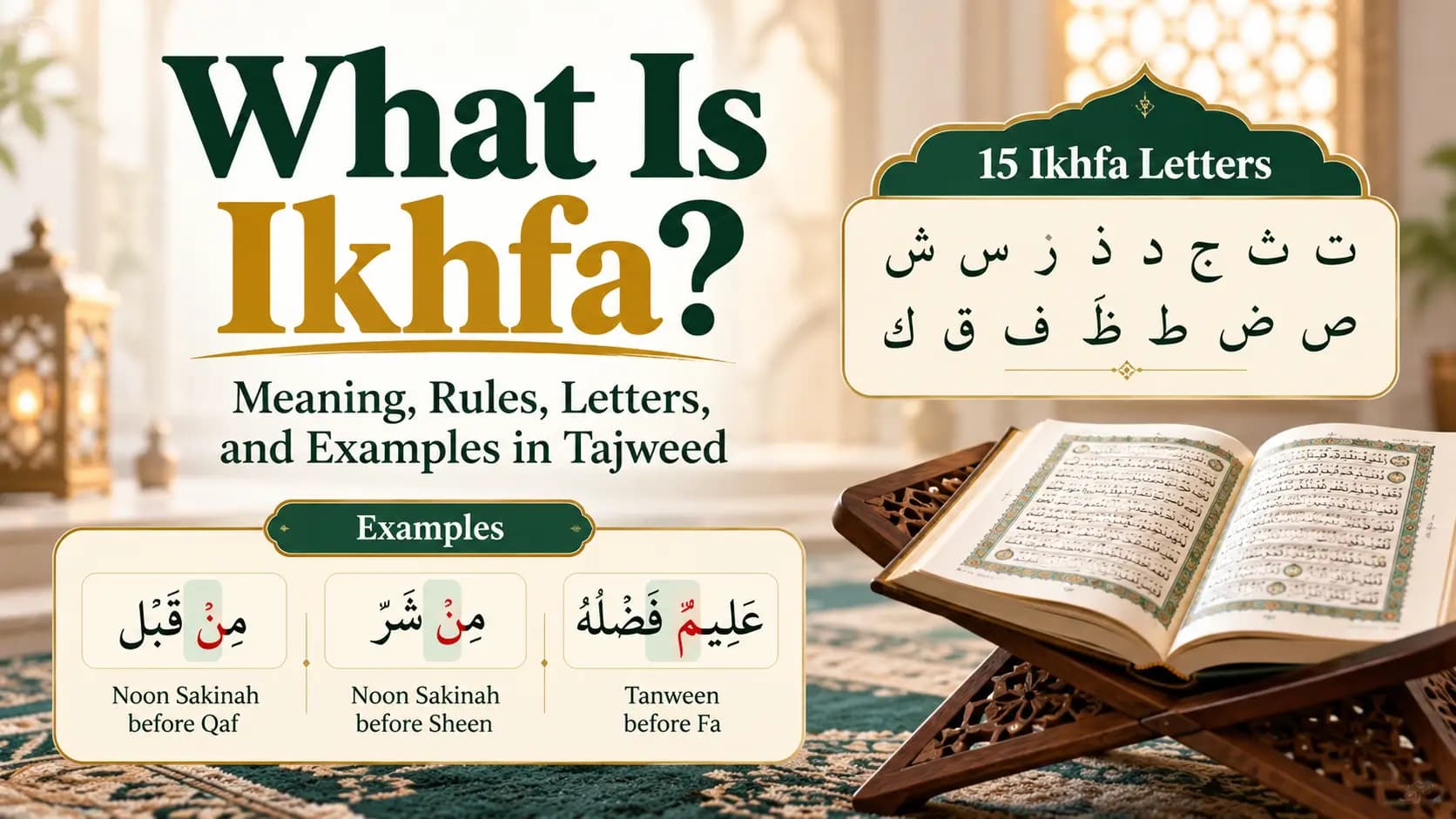
- Ikhfa
- Idgham
- Iqlab
- Izhar
- Waqf
- Characteristics of Arabic letters
The aim should not be to memorize a list of Tajweed definitions.
The real goal is to hear a mistake, understand why it is incorrect, and gradually correct it in your recitation.
Adults who already read Quran but want to improve pronunciation can study these areas through the Online Tajweed Course.
International Quran Academy currently structures its Tajweed teaching across beginner, intermediate, and advanced levels, allowing learners to work from their present ability rather than starting at the same point.
How Long Does It Take an Adult to Memorize the Quran?
Memorization requires a very different commitment from learning Quran reading.
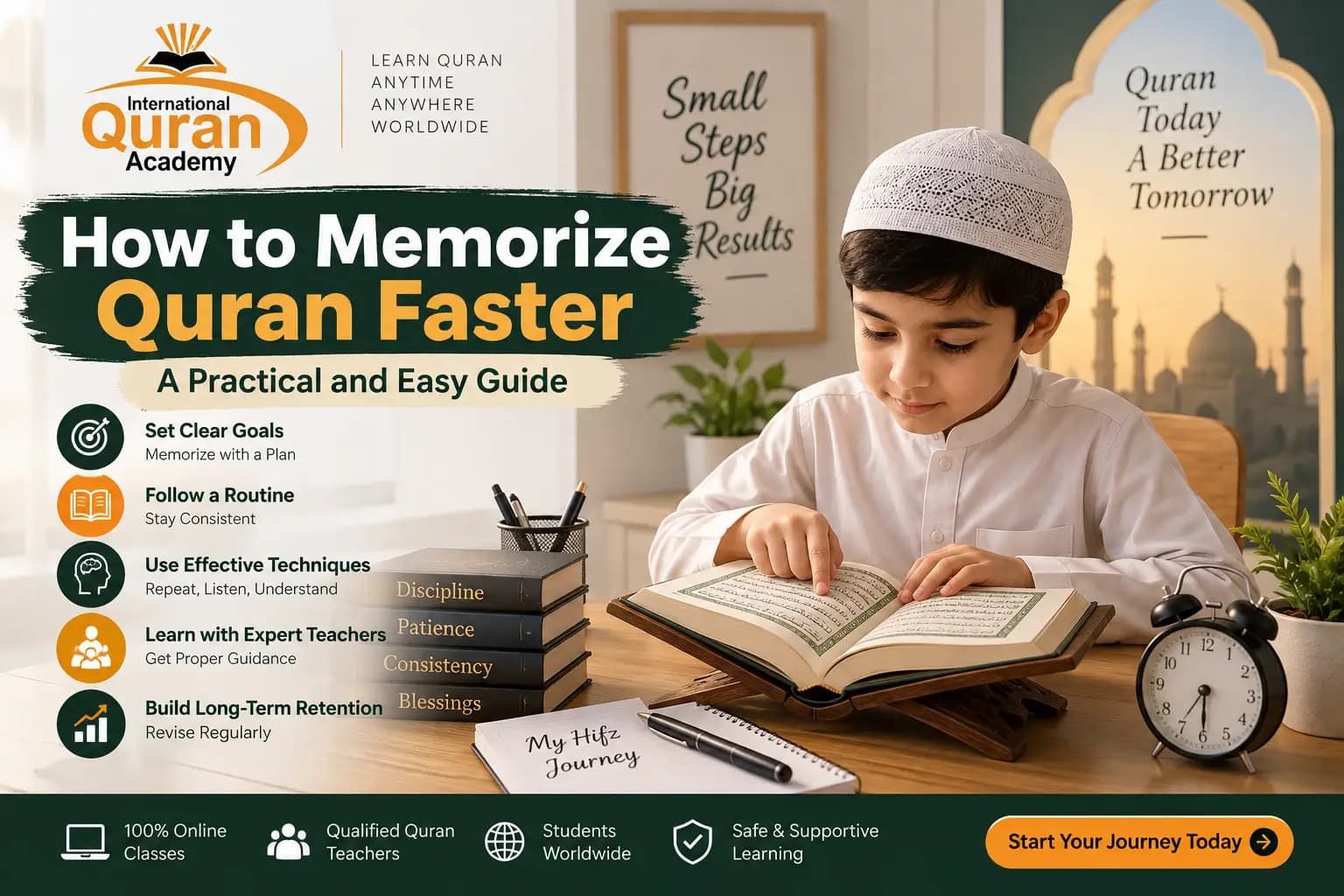
A highly consistent learner may complete Hifz in approximately two years or more, but adults should be particularly careful about treating this as a deadline.
Many adults require longer.
Your Hifz timeline depends on:
- How much you memorize every day
- How strong your Quran reading already is
- How well you know Tajweed
- How much time you dedicate to revision
- Your retention ability
- Your work and family responsibilities
- How regularly you attend classes
- How consistently you revise old portions
The most important part of Hifz is not simply memorizing a new page.
It is retaining what you previously memorized.
A sustainable Hifz routine usually includes three elements:
New lesson: The verses you are currently memorizing.
Recent revision: Material memorized recently.
Older revision: Previously memorized portions that must remain strong.
International Quran Academy offers individualized instruction through its Quran Memorization Course for students who want structured Hifz guidance. The academy describes its memorization program as personalized one-to-one teaching with experienced Hafiz teachers.
What About Learning to Understand the Quran?
Being able to recite the Quran does not automatically mean you understand Arabic.
Reading and understanding are separate skills.
If your goal is to understand Quranic Arabic, you may eventually need to study areas such as:
- Arabic vocabulary
- Pronouns
- Verb patterns
- Sentence structure
- Grammar
- Common Quranic words
- Morphology
- Context
- Translation
- Tafseer
A structured Arabic program can take around a year to establish a useful foundation, with deeper mastery continuing beyond that.
If understanding the language itself is your goal, explore the Arabic Language Course.
If you want to study meanings and explanations rather than learning Arabic as a language, the Quran Tafseer Course may be the more appropriate next step.
7 Factors That Determine How Quickly an Adult Learns Quran
There is no universal Quran-learning timeline because several variables affect progress.
1. Your Starting Level
A complete beginner and someone who studied Quran as a child should not expect the same timeline.
Many adults return to Quran learning after years away.
You may feel as though you have forgotten everything, but previous exposure can sometimes help skills return more quickly.
A teacher should assess your actual level rather than automatically placing you in a beginner course.
2. How Often You Take Classes
Consistency has a major influence on progress.
Compare these two schedules:
Student A:
30 minutes once per week.
Student B:
30 minutes five times per week.
Even if both students have similar ability, their progress is unlikely to be identical.
Frequent contact with Quranic Arabic helps reinforce letter recognition, pronunciation, and reading patterns.
For many adults, three to five focused lessons per week combined with personal revision can create a strong routine.
3. How Much You Practice Between Lessons
Your teacher can guide you, but your progress also depends on what happens after class.
Even 10–20 minutes of focused daily revision can be more useful than waiting for the next lesson without reviewing anything.
A simple routine may be:
5 minutes reviewing letters or Tajweed rules.
10 minutes repeating the day's lesson.
5 minutes reading previously completed material.
Small amounts of consistent practice accumulate.
4. Whether You Have a Qualified Teacher
Self-study resources can be useful, particularly for revision.
But Quran pronunciation is difficult to evaluate by yourself.
You may think you are pronouncing ح correctly when you are actually saying something closer to ه.
You may not notice that your Madd is too short.
You may not recognize when a letter is being produced from the wrong articulation point.
A teacher provides immediate feedback that videos and books cannot always provide.
International Quran Academy currently offers one-to-one classes with male and female tutors, flexible scheduling, and multilingual instruction for learners in different countries.
5. Your Native Language
Arabic sounds may be easier for speakers of some languages than others.
If your first language contains sounds similar to Arabic letters, pronunciation may come more naturally.
English-speaking adults, for example, may initially struggle with throat letters because some Arabic sounds have no direct English equivalent.
This does not mean you cannot learn them.
It simply means some sounds require deliberate listening and repetition.
6. Your Age
Adults sometimes assume they are "too old" to learn Quran.
Age can affect learning style, but adulthood also provides advantages.
Adults can often:
- Understand explanations more deeply
- Follow structured practice
- Recognize patterns
- Ask specific questions
- Set personal goals
- Manage independent revision
- Understand why Tajweed rules matter
You do not need to learn exactly like a child.
A good teacher should adapt the method to an adult learner.
7. Your Consistency
This may be the most important factor of all.
Studying intensely for two weeks and then stopping for a month usually creates slower progress than maintaining a realistic schedule for six months.
A sustainable plan is better than an ambitious plan you cannot maintain.
How Many Minutes a Day Should an Adult Practice Quran?
You do not necessarily need hours every day.
For many beginners, 20 to 30 minutes of focused Quran practice daily is an excellent starting point.
You might divide that time into:
- 5 minutes: previous lesson revision
- 10 minutes: current lesson
- 5 minutes: pronunciation practice
- 5–10 minutes: independent Quran reading
More advanced students can increase the time according to their goals.
Hifz students, in particular, generally need substantially more revision time than beginners learning Qaida.
Is It Harder to Learn Quran as an Adult?
It can feel difficult at first, but difficulty does not mean inability.
Adults often face challenges that children do not:
Limited time
Work, parenting, study, and household responsibilities compete for attention.
Fear of mistakes
Some adults feel embarrassed when reading in front of a teacher.
A good Quran teacher understands that mistakes are part of the learning process.
Old pronunciation habits
If you have read certain words incorrectly for many years, changing them can take repetition.
Inconsistent schedules
Travel, work shifts, and family commitments can interrupt learning.
These problems can be managed with structured, flexible lessons and realistic expectations.
Can I Learn Quran in 3 Months?
You can make significant progress in three months.
Whether you can "learn the Quran" in that period depends entirely on your starting point and your definition of learning.
A complete beginner may use three months to:
- Learn Arabic letters
- Understand vowel signs
- Join letters
- Read basic words
- Develop foundational pronunciation
Someone who already reads may use those same three months to improve fluency or correct Tajweed weaknesses.
Rather than asking:
"Can I finish in three months?"
Ask:
"What meaningful improvement can I achieve in three months?"
That creates a healthier and more realistic learning goal.
Can an Adult Learn Quran Without Knowing Arabic?
Yes.
You do not need to speak Arabic before learning Quran recitation.
Many Muslims around the world learn to read the Quran without being fluent Arabic speakers.
Quran reading classes typically teach students how Arabic letters are pronounced and combined.
However, reading Arabic and understanding Arabic are different skills.
If your long-term goal includes understanding Quranic vocabulary and meaning, Arabic language study can later complement your recitation lessons.
Can I Learn Quran by Myself?
You can use books, recordings, apps, and online resources to support your learning.
However, beginners should ideally have access to a qualified teacher, particularly for pronunciation.
The major difficulty with self-learning is that you may not recognize your own errors.
A recording can show you how a letter should sound.
It cannot always tell you why your pronunciation is incorrect.
A teacher can listen, identify the problem, and give specific correction.
Self-study therefore works best as a support system, not necessarily as a complete replacement for guided recitation instruction.
A Practical 6-Month Quran Learning Plan for Adults
Every student is different, but a structured beginner plan might look like this:
Month 1: Arabic Foundations
Focus on:
- Arabic alphabet
- Letter recognition
- Basic Makharij
- Short vowels
- Simple combinations
Month 2: Joining and Reading
Work on:
- Joined letters
- Sukoon
- Tanween
- Shaddah
- Madd
- Simple Arabic words
Month 3: Qaida Completion and Quran Preparation
Practice:
- Longer words
- Common Quranic patterns
- Introductory Tajweed
- Controlled reading
- Pronunciation correction
Month 4: Begin Reading Quran
Start reading directly from the Quran with teacher guidance.
Focus on accuracy before speed.
Month 5: Build Fluency
Increase continuous reading while correcting repeated pronunciation mistakes.
Month 6: Strengthen Reading and Tajweed
Review weak areas and begin applying Tajweed more consistently.
Some learners will move faster than this.
Others will require additional months.
Both are normal.
How to Learn Quran Faster Without Rushing
Learning faster should mean learning more effectively—not skipping foundations.
A few habits can improve your progress considerably.
Keep lessons frequent
Short, regular lessons are often better than occasional long sessions.
Practice every day
Even a small daily session keeps Arabic patterns familiar.
Read aloud
Quran recitation is a spoken skill. Silent reading alone cannot develop pronunciation.
Record yourself
Listening back can help you notice hesitation and repeated mistakes.
Focus on repeated errors
If the same letter causes problems repeatedly, spend extra time on that letter instead of simply moving forward.
Revise old lessons
Progress is not only about learning new material.
Ask your teacher questions
If you do not understand why something is pronounced a certain way, ask.
Understanding can improve retention.
What If I Have Tried Before and Stopped?
Start again.
Many adults have begun learning Quran more than once.
A previous attempt is not wasted.
You may already recognize letters, remember certain rules, or have stronger familiarity with the Mushaf than a complete beginner.
Instead of restarting automatically from lesson one, ask a teacher to assess you.
You may only need targeted revision before continuing.
How International Quran Academy Supports Adult Learners
Adult learners often need a different learning environment from children.
Work schedules, family responsibilities, previous Quran experience, language, and individual learning pace all need to be considered.
International Quran Academy currently offers live one-to-one Quran classes, male and female tutors, flexible schedules, and courses ranging from beginner Quran reading to Tajweed, Hifz, Tafseer, Arabic, and Islamic studies.
This allows an adult learner to begin at the appropriate level rather than following a fixed curriculum designed for everyone.
If you do not know where to start, you can use the academy's 3-Day Free Trial Quran Classes to have your current ability evaluated before choosing a regular study plan.
Frequently Asked Questions
How long does it take an adult to learn to read Quran?
Many consistent adult beginners can build meaningful Quran-reading ability within approximately six to eight months. Some progress faster, while others need longer depending on their starting level, class frequency, pronunciation, and personal practice.
Can I learn Quran at age 30, 40, 50, or older?
Yes. There is no requirement to begin Quran learning during childhood. Adults can start at any stage of life, although the teaching approach and pace should be adapted to their needs.
How long does it take to learn Quran with Tajweed?
If you already read Quran, several months of focused Tajweed study can significantly improve pronunciation and rule application. A structured Tajweed program commonly requires around four to six months for foundational development, while refinement continues through ongoing recitation.
How long should I study Quran every day?
For a beginner, 20–30 minutes of focused daily practice can be a practical starting point. Your teacher may recommend more depending on whether you are studying reading, Tajweed, Arabic, or Hifz.
Can I learn Quran online as an adult?
Yes. Online one-to-one lessons can allow adults to learn from home, choose suitable lesson times, receive direct pronunciation feedback, and study according to their own pace.
Do I need to learn Arabic before reading Quran?
No. You can learn Quran recitation without first becoming fluent in Arabic. However, studying Arabic later can help you understand Quranic vocabulary and meaning more deeply.
Is Tajweed necessary for beginners?
Beginners should start learning correct pronunciation from the beginning. Detailed Tajweed terminology can be introduced gradually as the learner becomes more comfortable reading.
How long does Quran memorization take for adults?
The timeline varies greatly. An adult with strong recitation, consistent daily memorization, and substantial revision time may complete Hifz in a few years, while others may take considerably longer. Retention and revision should be prioritized over finishing quickly.
Final Answer: How Long Does It Take an Adult to Learn Quran?
There is no single deadline.
If you are starting from zero, six to eight months of regular study can be a realistic target for developing a useful Quran-reading foundation, while Tajweed, fluency, Arabic understanding, and memorization require additional time.
Your progress depends mainly on:
- Your current level
- How frequently you study
- The quality of your teaching
- Daily practice
- Revision
- Your learning goals
- Consistency over time
Do not measure your Quran journey against another student's timeline.
Someone may complete Qaida quickly but struggle with pronunciation.
Someone else may progress slowly but build exceptionally strong foundations.
The better measure is simple:
Can you read more correctly today than you could a month ago?
If the answer is yes, you are progressing.
And if you have been delaying because you believe adulthood makes it too late to begin, the most important step is not calculating exactly how long the journey will take.
It is starting it.
International Quran Academy offers structured Quran learning for adults from beginner reading through advanced Tajweed, Quran memorization, Arabic, and Tafseer. You can begin with a free trial class to identify your current level and build a learning plan that matches your goals and schedule.