
Online Quran Classes for Women
Online Quran Classes for Women provide a convenient and structured way for women to learn Quran reading, Tajweed, memorization, Translation, Tafseer, Arabic, and Islamic Studies with a female Quran teacher from home.
Whether you are opening a Qaida for the first time, returning to Quran learning after several years, trying to correct long-standing pronunciation mistakes, or looking for advanced Quranic study, you should not have to fit into a course designed for someone else's level.
Your Quran learning should begin where you are now.
Women can learn with qualified female Quran teachers, receive direct recitation correction, select suitable class timings, and progress through lessons according to their current ability and learning goals.
Regular Quran lessons are generally 30–35 minutes, while Hifz classes normally require around 40–45 minutes to allow sufficient time for new memorization and revision.
New students can also begin with a 3-day free trial before deciding whether the teacher and learning arrangement are right for them.
Learn Quran Online with a Female Quran Teacher
For many women, learning directly with another woman creates a more comfortable environment for recitation, questions, correction, and regular study.
A female student can request one of our qualified female Quran teachers according to her course, preferred language, schedule, and teacher availability.
But having a female teacher is only one part of effective Quran learning.
A capable Quran teacher should first understand what the student already knows.
For example, one woman may still struggle to distinguish similar Arabic letters. Another may read complete pages fluently but repeatedly make mistakes in Makharij. A third may understand basic Tajweed but find it difficult to apply the rules while actually reciting.
These students should not receive identical lessons.
The teacher should identify the student's current level, recurring mistakes, strengths, and learning objectives before deciding what needs the most attention.
That is why our approach focuses on level-based learning, direct correction, revision, and steady progression rather than simply completing a fixed number of pages.
Who Are Our Online Quran Classes for Women Designed For?
These classes can benefit women at very different stages of Quran learning.
A complete beginner may need to begin with Arabic letters and Qaida.
A woman who already reads Arabic may need help developing fluency.
An experienced reader may want detailed Tajweed and Makharij correction.
Another student may want to memorize the Quran, while someone else may be more interested in understanding Quranic meanings through Translation and Tafseer.
Our classes are suitable for adult beginners, university students, working women, mothers, homemakers, women returning to Quran learning after a long break, Hifz students, and learners seeking more advanced Quranic education.
Age does not determine where a student should begin.
Ability does.
How Do We Determine Your Quran Learning Level?
Before planning long-term lessons, it is useful for the teacher to understand the student's existing Quran-reading ability.
Depending on the selected course, a teacher may evaluate:
- Arabic-letter recognition and pronunciation
- Ability to join letters and read Quranic words
- Reading fluency
- Makharij and pronunciation errors
- Practical application of Tajweed
- Previous memorization
- Revision strength
- Previous Quran-learning experience
- Understanding of Translation or Arabic where relevant
This is not intended to be an examination.
It simply helps determine the most appropriate place to begin.
For example, a woman who can already read fluently but makes several recurring pronunciation mistakes may benefit more from targeted Tajweed correction than from restarting the entire Qaida.
On the other hand, moving a complete beginner into Quran recitation before she has developed a strong reading foundation can make later progress more difficult.
Online Quran Courses for Women
Women can select a course according to their current ability and learning objectives.
Noorani Qaida Classes for Women
Women who cannot yet read Arabic can begin with our Noorani Qaida Course.
Qaida establishes the reading foundation needed before independent Quran recitation.
Students progressively learn Arabic letters, their different forms, vowel sounds, joining letters, pronunciation, reading patterns, and foundational Tajweed concepts.
Particular attention should be given to pronunciation at this stage.
If a learner repeatedly pronounces an Arabic letter incorrectly during the beginning stages, that pronunciation can become a habit and require considerably more correction later.
For this reason, the objective is not simply to finish the Qaida quickly.
The objective is to develop a foundation that makes future Quran reading easier and more accurate.
Quran Reading Classes for Women
Women who recognize Arabic letters but still need assistance with fluent recitation can progress to our Quran Reading Course.
During live lessons, the student reads directly to her teacher.
The teacher listens for errors involving pronunciation, fluency, Arabic vowel signs, Makharij, pauses, repeated mistakes, and relevant Tajweed rules.
The student can then repeat difficult words or verses until the correction becomes clearer.
This live correction is particularly valuable because learners do not always recognize their own recitation mistakes.
The goal is gradual improvement in accuracy, fluency, pronunciation, and confidence, rather than merely increasing the number of pages completed.
Online Tajweed Classes for Women
Women who can already read the Quran but want to improve the quality and accuracy of their recitation can join an online Tajweed course.
Tajweed is most useful when it moves beyond memorizing the names of rules.
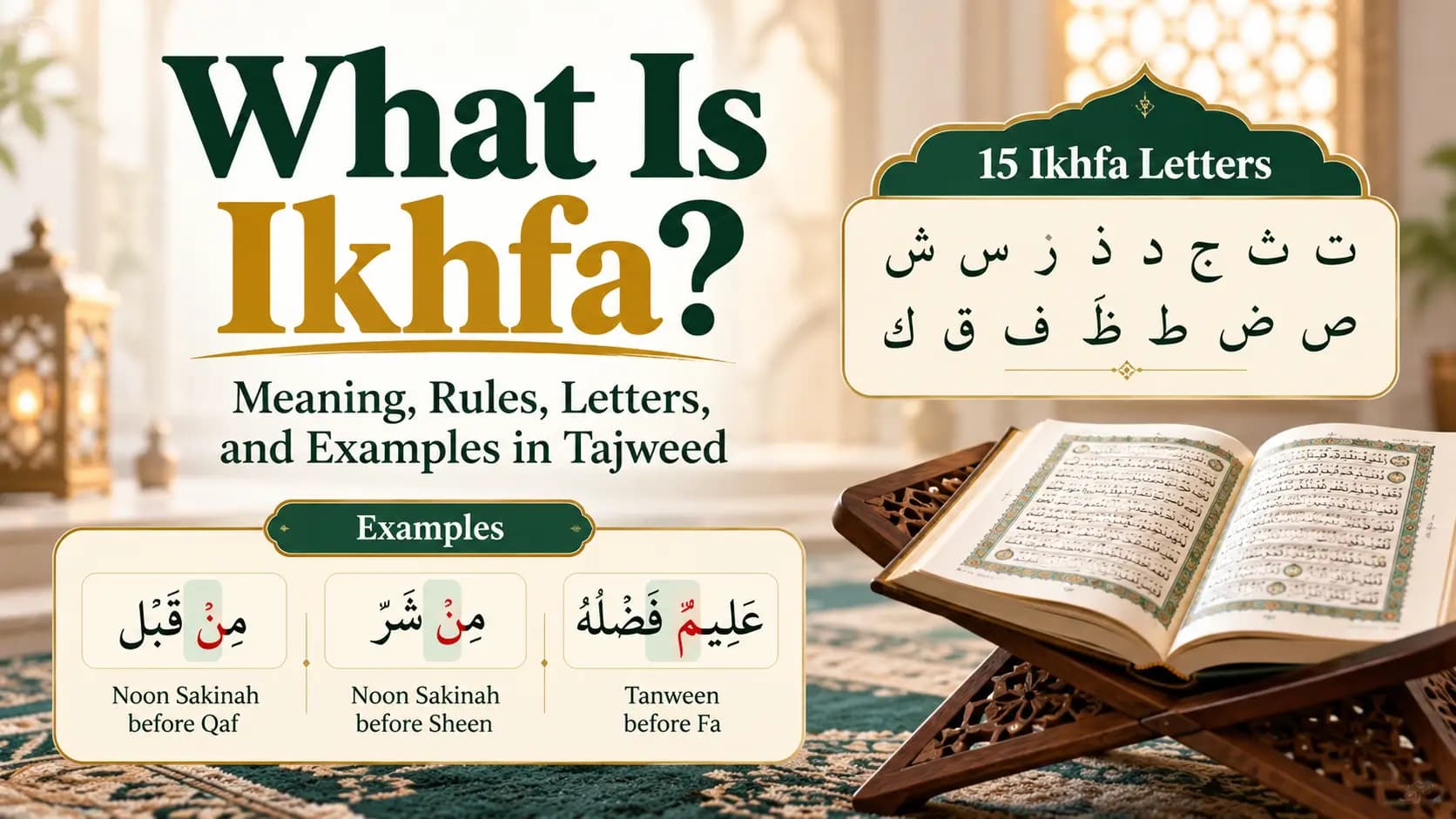
A learner may know what Ikhfa, Idgham, Qalqalah, Madd, or Ghunnah means and still struggle to apply those rules naturally while reading.
That is why our teaching approach combines explanation with practical recitation.
Depending on the student's existing level, lessons may address:
Makharij, characteristics of Arabic letters, Noon Sakinah and Tanween, Meem Sakinah, Ghunnah, Qalqalah, Madd, stopping and continuation, and other practical aspects of Quranic recitation.
Our Tajweed program generally takes approximately 4–6 months, although the actual duration depends on previous knowledge, class frequency, practice outside class, and individual progress.
Can Tajweed Really Be Learned Online?
Yes.
In a live online Tajweed class, the teacher can listen as the student recites, identify a mistake, demonstrate the correct pronunciation, and ask the student to repeat it.
This immediate correction and repetition are important parts of Tajweed training.
Online Hifz Classes for Women
Women who want to memorize the Holy Quran can join our Quran memorization course.
Effective Hifz is not simply about memorizing new verses every day.
In our experience teaching Quran students, memorization becomes more reliable when three areas receive consistent attention:
New lesson: the portion currently being memorized.
Recent revision: material memorized during recent lessons.
Older revision: previously memorized portions that must remain strong.
A student who continually memorizes new verses without maintaining older portions may progress quickly at first but later discover weaknesses in previous memorization.
For this reason, revision should remain part of the Hifz routine.
Students may work toward selected Surahs, individual Ajza, or complete Quran memorization according to their goals.
Hifz classes generally last approximately 40–45 minutes because sufficient time is required for both new memorization and revision.
Quran Translation Classes for Women
Reciting the Quran is deeply important, but many women also want to understand what they are reading.
Our Quran Translation Course helps students study Quranic meanings in a language they understand.
Depending on the student's level and selected program, lessons may include verse translation, important vocabulary, explanation of key concepts, and discussion of the lessons contained within a passage.
Translation classes can be particularly beneficial for women who have been reading the Quran for years and now want to develop a stronger connection with its meanings.
Online Tafseer Classes for Women
Women seeking deeper Quranic study can progress to an online Tafseer course.
Tafseer goes beyond translating individual words.
It helps students explore meanings, themes, explanations, context, and important lessons within Quranic passages.
A structured Tafseer class also gives students the opportunity to ask questions rather than depending entirely on independent reading or short online explanations.
The appropriate depth of study should depend on the student's existing knowledge and learning objectives.
Arabic Language Classes for Women
Women who want to strengthen their understanding of Arabic can study through our Arabic Language Course.
Learning Arabic can provide valuable support for students interested in Quranic vocabulary, sentence structure, Tafseer, Hadith, and broader Islamic learning.
Depending on the student's existing level, lessons may cover reading, vocabulary, grammar, comprehension, sentence formation, and other aspects of Arabic.
Students whose long-term goal is understanding the Quran in greater depth may benefit from combining Quran studies with structured Arabic learning.
Islamic Studies for Women
Women can also study essential Islamic knowledge through our Islamic Studies Course.
Depending on the learning program, lessons may include Salah, purification, daily Duas and Azkar, Hadith, Islamic manners, foundational beliefs, and other practical areas of Islamic education.
This option can be useful for women who want a broader Islamic learning program alongside Quran recitation.
Our Teaching Approach for Women
A useful Quran-learning plan should not be based only on how quickly a student moves through pages.
We focus on four principles:
Accuracy before speed.
Recurring mistakes should be corrected rather than ignored simply to finish a lesson.
Teach according to ability.
A beginner, intermediate reader, Tajweed student, and Hafiz require different teaching approaches.
Revision matters.
Previously learned material needs reinforcement, particularly in Hifz and pronunciation training.
Consistency matters more than unrealistic intensity.
A schedule that a student can maintain for months is usually more useful than an intensive schedule she cannot continue.
These principles allow teachers to adjust lessons according to the learner rather than expecting every learner to progress identically.
Online Quran Classes for Complete Beginner Women
Yes, a woman can begin learning Quran online even if she does not recognize a single Arabic letter.
There is no requirement to have previous Arabic or Quran-reading knowledge.
Beginners can start with Arabic-letter recognition and pronunciation before moving progressively into joining letters, Quranic words, short passages, and eventually Quran recitation.
Adult learners sometimes feel uncomfortable admitting that they need to start from Qaida.
They should not.
Starting with the correct foundation is far more valuable than beginning at an advanced level simply because of age.
A skilled teacher should meet the learner where she is.
Quran Classes for Working Women, Students and Mothers
One of the most common obstacles to consistent Quran study is not willingness to learn.
It is time.
Working women may need classes before or after work.
University students may need to schedule lessons around lectures and examinations.
Mothers may need a class time that works around their children's routines.
Online learning eliminates travelling time and makes it easier to choose a manageable schedule.
Regular lessons generally last around 30–35 minutes, making Quran learning easier to incorporate into a normal weekly routine.
Students can choose the number of weekly lessons according to their objectives and availability.
Those who want faster progress may select more weekly classes, while busy learners can begin with fewer classes and concentrate on maintaining consistency.
How Our Online Quran Classes for Women Work
Step 1: Choose Your Learning Goal
Decide whether you want to study Qaida, Quran Reading, Tajweed, Hifz, Translation, Tafseer, Arabic, Islamic Studies, or another available Quranic subject.
If you are unsure, the teacher can help determine your appropriate starting level.
Step 2: Tell Us Your Preferences
Provide your preferred class days, timings, teaching language, course, and female-teacher preference.
Step 3: Meet Your Teacher
A suitable teacher is assigned according to your requirements and availability.
Step 4: Take Your 3-Day Trial
New students can begin through our 3-day free trial.
The trial allows you to experience the teaching style and gives the teacher an opportunity to understand your current level.
Step 5: Choose Your Regular Schedule
If you are satisfied after the trial, you can select your regular class schedule and continue learning.
You can also review our class fees and plans before selecting the schedule that best suits your requirements.
How Long Is Each Online Quran Class?
Most regular Quran lessons are approximately 30–35 minutes.
Hifz classes generally last 40–45 minutes because memorization requires additional time for listening and revision.
Class frequency depends on the learner.
A student looking for intensive progress may prefer four or five lessons each week.
Another woman may find two or three consistent weekly lessons more manageable.
There is no benefit in choosing a demanding schedule that cannot be maintained.
The best schedule is one that provides sufficient learning time while remaining realistic for the student.
What Languages Can Women Learn Quran In?
Depending on teacher availability, instruction can be provided in languages including:
English, Urdu, Hindi, Arabic, and other supported languages.
Using a language the student understands clearly can be especially important when a teacher needs to explain pronunciation, Tajweed rules, Arabic concepts, Translation, or Tafseer.
Learn Quran Online from Anywhere
Online classes remove geographical restrictions from Quran learning.
Women living in the United States, United Kingdom, Canada, Australia, Saudi Arabia, UAE, Pakistan, Europe, and other regions can study without needing a suitable Quran academy or female teacher to be physically located nearby.
Lessons are primarily conducted through Zoom, with other supported online platforms available when required.
A student normally needs only a reliable internet connection, a suitable device, working audio, and a quiet place to attend her lesson.
Why Choose Personalized Quran Classes for Women?
Recorded Quran lessons, apps, and videos can all provide useful support.
However, they cannot always tell you that you personally pronounced a letter incorrectly.
That is where live instruction becomes particularly valuable.
During a live class, a teacher can hear the student's recitation, identify the specific mistake, explain what went wrong, demonstrate the correct pronunciation, and listen again as the student repeats it.
This feedback loop is difficult to replace with passive learning alone.
Personalized instruction is especially useful for Tajweed, Makharij, Quran reading, and Hifz because these subjects depend heavily on accurate recitation and regular correction.
Frequently Asked Questions About Online Quran Classes for Women
Can women learn Quran online?
Yes. Women can study Quran reading, Tajweed, Hifz, Translation, Tafseer, Arabic, and Islamic Studies through live online lessons with a Quran teacher.
Can I choose a female Quran teacher?
Yes. Female students can request a female teacher. Assignment depends on the student's course, preferred language, schedule, and available teachers.
Can I start if I know nothing about Arabic?
Yes. Complete beginners can begin with Arabic letters and Qaida before gradually progressing toward Quran reading.
Which course should a beginner woman start with?
A woman who cannot yet recognize or join Arabic letters will generally benefit from beginning with Qaida. Someone who already reads Arabic should first have her current reading ability evaluated so that she can begin at an appropriate level.
How long does an online Quran lesson last?
Regular lessons generally last 30–35 minutes, while Hifz lessons normally last around 40–45 minutes.
How long does it take to learn Tajweed?
Our Tajweed program generally takes approximately 4–6 months, although actual progress varies according to the learner's starting level, practice, class frequency, and ability to apply the rules during recitation.
Can working women join online Quran classes?
Yes. Flexible scheduling makes online Quran learning suitable for working women, university students, mothers, and others with busy schedules.
Can women memorize the Quran online?
Yes. A teacher can listen to new memorization, correct mistakes, review recent lessons, and supervise revision of older memorized portions through live online classes.
Can I study Quran Translation and Tafseer online?
Yes. Women can study Quran Translation to understand Quranic meanings and progress to Tafseer for deeper explanation and contextual study.
Do I need a computer?
Not necessarily. Students can generally attend classes using a laptop, desktop computer, tablet, or smartphone with reliable internet access and functioning audio.
Is there a free trial?
Yes. New students can take a 3-day free trial before beginning regular paid lessons.
Start Your Quran Learning Journey
You do not need perfect Arabic.
You do not need previous Quran-reading experience.
And you do not need to wait until your schedule becomes completely free.
You need the right starting point, a suitable teacher, regular correction, and consistency.
Whether your goal is to read the Quran for the first time, correct your Tajweed, strengthen your recitation, memorize Quran, understand Translation and Tafseer, or study Arabic and Islam in greater depth, your learning plan can begin according to your current level.
Start with 3 Days of Free Trial Classes
Meet your teacher, experience the teaching method, discuss your learning goals, and decide whether the classes are right for you before beginning regular enrollment.
Learn from your level.
Progress at your pace.
Build a relationship with the Quran that you can continue consistently.