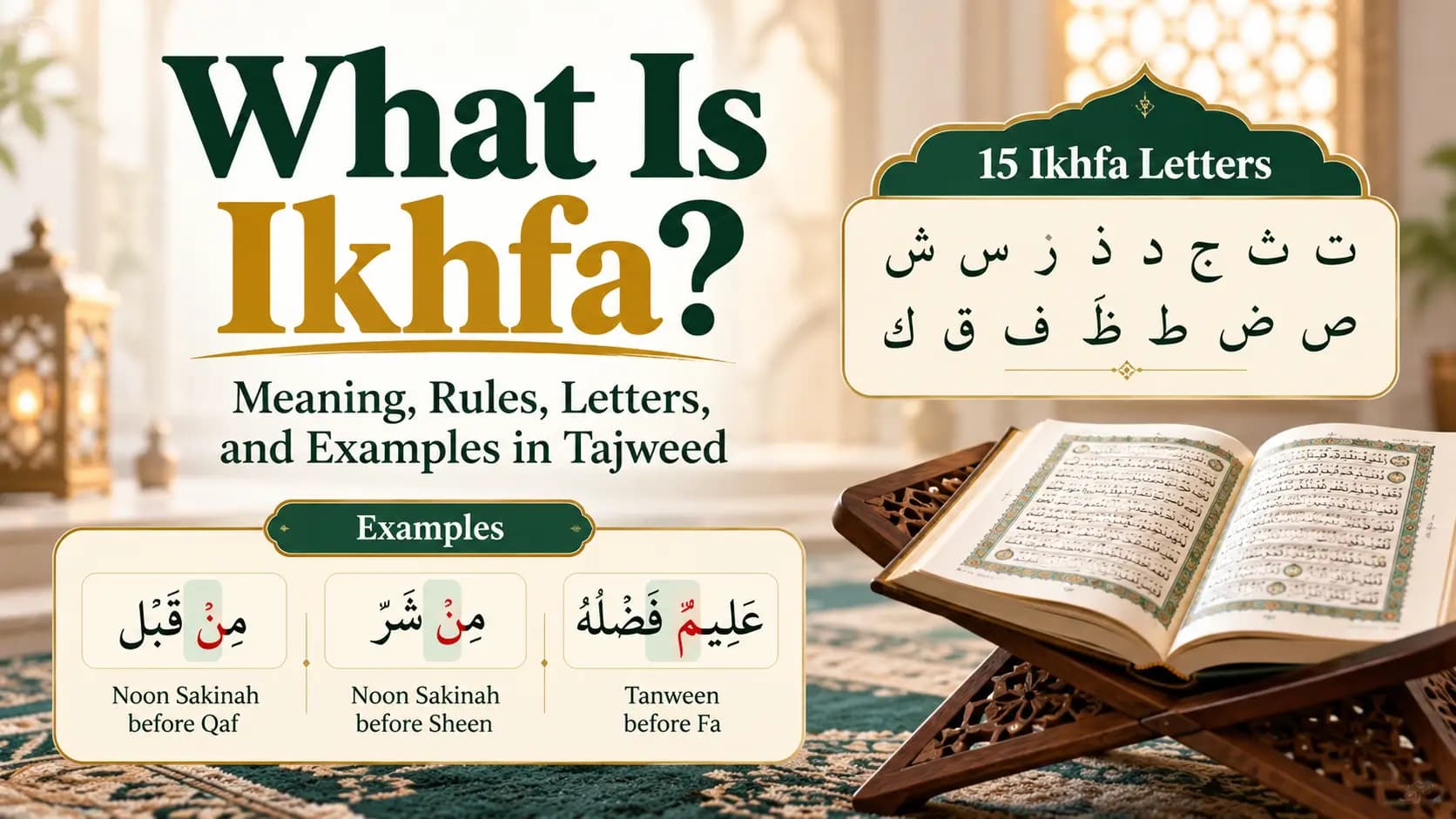

Reading the Quran correctly is not only about recognizing Arabic letters and joining words together. Each letter of the Quran has a proper point of articulation, specific characteristics, and rules that determine how it should be pronounced in different situations. These principles are known as Tajweed rules.
For beginners, words such as Ikhfa, Idgham, Iqlab, Ghunnah, and Qalqalah can sound complicated. However, Tajweed becomes much easier when the rules are learned in a logical order, explained in simple language, and practiced with real Quranic examples.
In this complete guide to Tajweed rules, you will learn the essential rules of Quran recitation step by step. We will cover Makharij al-Huruf, Sifaat al-Huruf, Noon Sakinah and Tanween, Meem Sakinah, Ghunnah, Qalqalah, Madd, Tafkheem and Tarqeeq, the rules of Raa and Laam, Hamzat al-Wasl, and Waqf and Ibtida.
Whether you are completely new to Tajweed, helping your child learn Quran, or trying to correct mistakes in your own recitation, this guide is designed to make the rules easier to understand and apply.
What Is Tajweed?
Tajweed (تجويد) is the science of reciting the Quran correctly by pronouncing each Arabic letter from its proper point of articulation and giving every letter its appropriate characteristics and rights during recitation.
In simple terms:
Tajweed teaches us how to pronounce the words and letters of the Quran correctly.
The word Tajweed comes from the Arabic root associated with making something good, excellent, or correct. When used in relation to Quran recitation, it refers to improving and perfecting the way the Quran is pronounced according to established rules of recitation.
Tajweed is therefore not simply about having a beautiful voice. A person may have a pleasant voice but still make pronunciation mistakes. Likewise, someone may have a simple voice but recite accurately by observing the rules of Tajweed.
What Does Tajweed Teach You?
Learning Tajweed helps a Quran student understand:
- the correct pronunciation of Arabic letters;
- where each letter originates in the mouth or throat;
- the characteristics that distinguish similar Arabic letters;
- when a sound should be clear, concealed, merged, or changed;
- when Ghunnah or nasalization should be used;
- how long certain vowel sounds should be extended;
- when letters should be pronounced heavily or lightly;
- how Qalqalah is produced;
- where to stop during Quran recitation; and
- how to restart correctly after stopping.
A student who understands these principles can gradually move from simply reading Arabic words to reciting the Quran with greater accuracy and confidence.
If you want guided practice rather than learning the rules only in theory, International Quran Academy's Online Tajweed Course provides structured Tajweed learning with teacher-led recitation and correction.
Why Is Tajweed Important When Reading the Quran?
Tajweed is important because the Quran was revealed in Arabic, and Arabic pronunciation depends on precise sounds.
Allah says:
وَرَتِّلِ الْقُرْآنَ تَرْتِيلًا
“And recite the Quran with measured recitation.”
Surah Al-Muzzammil, 73:4
Learning proper recitation helps a student preserve the pronunciation of Quranic words instead of replacing unfamiliar Arabic sounds with similar sounds from their own language.
Tajweed Helps Preserve Correct Pronunciation
Arabic contains several letters that can initially sound similar to beginners even though their pronunciation is different.
Consider these pairs:
س — ص
ت — ط
د — ض
ك — ق
ح — ه
ع — ء
For example, س and ص are not interchangeable. Similarly, ك and ق have different articulation points and characteristics.
A learner therefore needs more than the ability to recognize the written letter. The learner must train the tongue, lips and throat to produce the correct sound.
This is one of the main purposes of studying Tajweed.
Tajweed Helps Prevent Recitation Mistakes
Without proper pronunciation training, a learner may:
- replace one Arabic letter with another;
- make a short vowel unnecessarily long;
- shorten a sound that requires Madd;
- pronounce a heavy letter as light;
- pronounce a light letter too heavily;
- miss required Ghunnah;
- add Ghunnah where it does not belong;
- incorrectly apply Qalqalah; or
- stop at an unsuitable place in a verse.
Learning Tajweed helps students recognize and gradually correct these errors.
Tajweed Makes Quran Recitation More Consistent
A student who does not know Tajweed may pronounce the same combination of letters differently each time it appears.
Tajweed provides a system.
Once you understand why Noon Sakinah is pronounced differently before certain letters, for example, you can recognize the same rule whenever it occurs elsewhere in the Quran.
This turns Tajweed from a collection of sounds that must be copied into a set of principles that can be understood and applied.
Is Tajweed Only for Advanced Quran Students?
No. Tajweed is relevant to both beginners and advanced students, but the depth of Tajweed study should match the learner's level.
A beginner does not need to memorize dozens of technical terms on the first day.
Instead, beginners should start with:
- recognizing Arabic letters;
- learning their correct sounds;
- understanding Fathah, Kasrah and Dammah;
- learning Sukoon and Shaddah;
- recognizing Tanween;
- understanding basic Madd;
- developing correct Makharij; and
- gradually applying basic Tajweed rules.
Students who cannot yet read Arabic confidently may find it easier to establish these foundations through Noorani Qaida with Tajweed before moving into detailed Tajweed study.
What Are the Main Tajweed Rules?
There is no single universally fixed number that represents all Tajweed rules. Tajweed is a broad field, and teachers and textbooks may organize its subjects into different categories and subcategories.
However, the following are among the major topics students encounter when learning Quran Tajweed rules:
| Tajweed Topic | What It Teaches |
|---|---|
| Makharij al-Huruf | Correct articulation points of Arabic letters |
| Sifaat al-Huruf | Characteristics and qualities of letters |
| Noon Sakinah and Tanween | Izhar, Idgham, Iqlab and Ikhfa |
| Meem Sakinah | Izhar Shafawi, Idgham Shafawi and Ikhfa Shafawi |
| Ghunnah | Correct nasal resonance |
| Qalqalah | Controlled echoing quality of specific letters |
| Madd | Rules governing elongation |
| Tafkheem and Tarqeeq | Heavy and light pronunciation |
| Rules of Raa | When ر is pronounced heavily or lightly |
| Rules of Laam | Light and heavy pronunciation involving ل |
| Hamzat al-Wasl | Beginning and connecting pronunciation |
| Waqf and Ibtida | Correct stopping and restarting |
We will explain each of these areas separately throughout this guide.
Tajweed Rules at a Glance
Before studying every rule in depth, it helps to understand the overall picture.
| Rule | Simple Explanation | Key Letters or Concept |
|---|---|---|
| Izhar | Pronounce the Noon/Tanween clearly | ء هـ ع ح غ خ |
| Idgham | Merge Noon/Tanween into the next letter | ي ر م ل و ن |
| Iqlab | Change the Noon/Tanween sound toward a concealed Meem | ب |
| Ikhfa | Conceal the Noon/Tanween sound with Ghunnah | 15 letters |
| Meem Sakinah | Rules affecting مْ | Izhar, Idgham and Ikhfa Shafawi |
| Ghunnah | Nasal resonance | Mainly ن and م |
| Qalqalah | Echoing/bouncing quality | ق ط ب ج د |
| Madd | Lengthening vowel sounds | ا و ي and related conditions |
| Tafkheem | Heavy/full pronunciation | Applies to designated letters/conditions |
| Tarqeeq | Light/thin pronunciation | Applies according to the letter and context |
| Waqf | Correct stopping | Quranic stopping principles/signs |
Do not worry if this table seems like a lot to remember. The purpose is to give you a map of what lies ahead. Each rule becomes much easier once studied separately with examples.
What Should You Learn Before Advanced Tajweed Rules?
Before trying to memorize the detailed rules of Noon Sakinah, Madd, Qalqalah or Waqf, students should have a strong understanding of the basic signs used in Quranic Arabic.
These foundations include Harakat, Sukoon, Shaddah, Tanween and Madd letters.
Harakat: The Three Short Vowels
Harakat (حركات) are vowel marks that help determine how an Arabic letter is pronounced.
The three basic short vowels are Fathah, Kasrah and Dammah.
Fathah — َ
Fathah is written above a letter and normally gives the letter a short “a” sound.
For example:
بَ = ba
The sound should be short. It should not automatically be stretched into a long vowel.
Kasrah — ِ
Kasrah is written below a letter and normally produces a short “i” sound.
For example:
بِ = bi
Again, the vowel should remain short unless another rule requires elongation.
Dammah — ُ
Dammah is written above a letter and normally produces a short “u” sound.
For example:
بُ = bu
One of the basic skills in Quran reading is learning to distinguish these short vowels from long vowels.
Sukoon — ْ
Sukoon (سكون) indicates that the letter carries no short vowel after it.
For example:
بْ
When pronouncing a letter with Sukoon, the student should avoid accidentally adding a Fathah, Kasrah or Dammah after it.
This is particularly important because several major Tajweed rules involve sakin letters, including Noon Sakinah (نْ) and Meem Sakinah (مْ).
Shaddah — ّ
Shaddah (شَدَّة) indicates a doubled consonant.
For example:
رَبِّ
The letter carrying Shaddah should not be treated as though it were a normal single consonant.
Shaddah becomes particularly important when we study Noon Mushaddadah (نّ) and Meem Mushaddadah (مّ) because both have an important relationship with Ghunnah.
Tanween — ً ٍ ٌ
Tanween (تنوين) is represented by doubled vowel marks:
ـً — Fathatain
ـٍ — Kasratain
ـٌ — Dammatain
When reading continuously, Tanween produces an “n” sound at the end of the word.
This is why Tanween is studied alongside Noon Sakinah. The letter that follows Tanween determines whether the reader applies Izhar, Idgham, Iqlab or Ikhfa.
Madd Letters
The three primary letters associated with natural Madd are:
ا — و — ي
Under the appropriate conditions, they create long vowel sounds.
Students need to learn the difference between a short vowel and a long vowel.
This distinction becomes especially important when we study the complete rules of Madd, where different circumstances can affect the required length of a sound.
Makharij al-Huruf: The Foundation of Correct Tajweed Pronunciation
Before learning what happens when two letters meet, it is important to learn how individual Arabic letters are produced.
This area of Tajweed is known as Makharij al-Huruf (مخارج الحروف).
What Does Makharij al-Huruf Mean?
A Makhraj is the articulation point or place from which a letter emerges.
In practical terms, Makharij teach us where an Arabic letter should be produced.
Different Arabic sounds involve different parts of the:
- throat;
- tongue;
- teeth and surrounding areas;
- lips;
- oral cavity; and
- nasal passage.
If the articulation point is incorrect, one letter may begin to resemble another.
For example:
ق should not become ك
ص should not become س
ط should not become ت
ح should not become ه
This is why Makharij are considered a fundamental part of learning Tajweed.
What Are the Five Major Areas of Makharij?
The articulation points are commonly organized under five major regions:
- Al-Jawf (الجوف) — the oral/throat cavity
- Al-Halq (الحلق) — the throat
- Al-Lisan (اللسان) — the tongue
- Ash-Shafatan (الشفتان) — the two lips
- Al-Khayshum (الخيشوم) — the nasal passage
Let's understand each one.
Al-Jawf: The Oral Cavity
Al-Jawf (الجوف) refers to the open cavity of the mouth and throat.
It is associated with the Madd letters when they function as long vowels.
These are:
ا — و — ي
Unlike many consonants, these long vowel sounds do not depend on a fixed point of contact between the tongue and another part of the mouth.
The sound flows through the open cavity.
Al-Halq: The Throat
Al-Halq (الحلق) means the throat.
Six Arabic letters are associated with different regions of the throat:
ء هـ ع ح غ خ
For learning purposes, they can be organized into three general groups.
Deepest Throat Area
ء هـ
Middle Throat Area
ع ح
Upper Throat Area
غ خ
Learning these six letters is particularly useful because the same group appears again when we study Izhar Halqi, one of the four major rules of Noon Sakinah and Tanween.
Al-Lisan: The Tongue
Al-Lisan (اللسان) means the tongue.
A large number of Arabic letters involve different parts of the tongue interacting with the palate, gums, teeth or nearby areas.
Examples include:
ق ك ج ش ي ض ل ن ر ت د ط ص ز س ظ ذ ث
The exact tongue position varies considerably from one letter to another.
This explains why seemingly similar sounds can actually be different letters.
Why Tongue Position Matters
Consider:
س and ص
Both may sound similar to a beginner, but ص has characteristics that give it a heavier quality.
Similarly:
ت and ط
or:
ك and ق
These letters cannot be distinguished reliably by transliteration alone.
A student needs to hear the correct sound and train the mouth to reproduce it.
Students who can already read Arabic but struggle with pronunciation can use a structured Quran Recitation Course to practice these rules during actual recitation rather than studying them only as theory.
Ash-Shafatan: The Two Lips
Ash-Shafatan (الشفتان) means the two lips.
Letters associated with the lip region include:
ف ب م و
The position of the lips changes according to the particular letter.
Understanding the lips becomes especially important when we later study Meem Sakinah, because rules such as Ikhfa Shafawi and Idgham Shafawi depend on how Meem interacts with the following letter.
Al-Khayshum: The Nasal Passage
Al-Khayshum (الخيشوم) refers to the nasal passage.
It is associated with the nasal resonance known as Ghunnah (غنة).
Ghunnah is closely connected with:
ن — م
You will encounter Ghunnah repeatedly in Tajweed, including in:
- Noon Mushaddadah;
- Meem Mushaddadah;
- Ikhfa;
- Iqlab;
- Idgham with Ghunnah; and
- related applications involving Noon and Meem.
Later in this guide, we will explain what Ghunnah is, how long it is held, and common mistakes students make when producing it.
Why Should You Learn Makharij Before Memorizing Tajweed Rules?
Imagine that a student knows the definition of Ikhfa perfectly but continues to pronounce ق as ك.
The student may understand the rule theoretically, but the recitation itself still needs correction.
This teaches us an important principle:
Correct Tajweed begins with correct letters.
A productive learning sequence is:
- Hear the letter pronounced correctly.
- Understand where the sound originates.
- Practice producing the letter independently.
- Read the letter inside Quranic words.
- Apply Tajweed rules when the letter interacts with surrounding letters.
- Receive correction until the pronunciation becomes consistent.
This is also why listening alone is not always enough. A learner may believe that their pronunciation matches what they hear while unknowingly producing the sound from an incorrect articulation point.
Direct feedback can help identify mistakes that students may not notice themselves.
Makharij vs. Tajweed: What Is the Difference?
These terms are related but do not mean exactly the same thing.
Makharij specifically deal with the articulation points of letters.
Tajweed is broader. It includes Makharij but also covers letter characteristics, merging, concealment, nasalization, elongation, heaviness and lightness, stopping rules, and other aspects of Quranic recitation.
A simple way to remember the relationship is:
Makharij tell you where the letter comes from.
Sifaat tell you how the letter behaves and sounds.
Tajweed brings these principles and other recitation rules together.
Sifaat al-Huruf: Characteristics of Arabic Letters
Once we understand where letters are articulated, the next step is understanding their characteristics.
These characteristics are called Sifaat al-Huruf (صفات الحروف).
What Are Sifaat al-Huruf?
Sifaat means characteristics or qualities.
In Tajweed, Sifaat describe the qualities accompanying Arabic letters when they are pronounced.
Makharij and Sifaat work together.
Two letters can originate from close articulation areas but remain distinguishable because of their different characteristics.
Important Characteristics of Arabic Letters
Among the characteristics studied in Tajweed are:
- Hams (همس) — flow of breath;
- Jahr (جهر) — restraint of breath;
- Shiddah (شدة) — strong restriction of sound;
- Rikhwah (رخاوة) — flow of sound;
- Tawassut (توسط) — an intermediate state;
- Isti'la (استعلاء) — elevation;
- Istifal (استفال) — lowering;
- Itbaq (إطباق) — adhesion;
- Infitah (انفتاح) — openness;
- Safeer (صفير) — a whistle-like quality;
- Qalqalah (قلقلة) — an echoing/bouncing quality;
- Tafashshi (تفشي) — spreading of sound; and
- Istitalah (استطالة) — extension of sound.
Beginners should not feel that they need to memorize every technical term immediately.
The practical priority is learning to hear, distinguish and correctly pronounce the letters. As a learner progresses, studying the Sifaat in greater depth helps explain why each letter sounds the way it does.
What Comes Next?
Once a student understands the basic reading signs, Makharij and the concept of Sifaat, it becomes much easier to understand the rules governing letters when they occur together.
The next major area is one of the most important parts of Tajweed:
the four rules of Noon Sakinah and Tanween — Izhar, Idgham, Iqlab and Ikhfa.