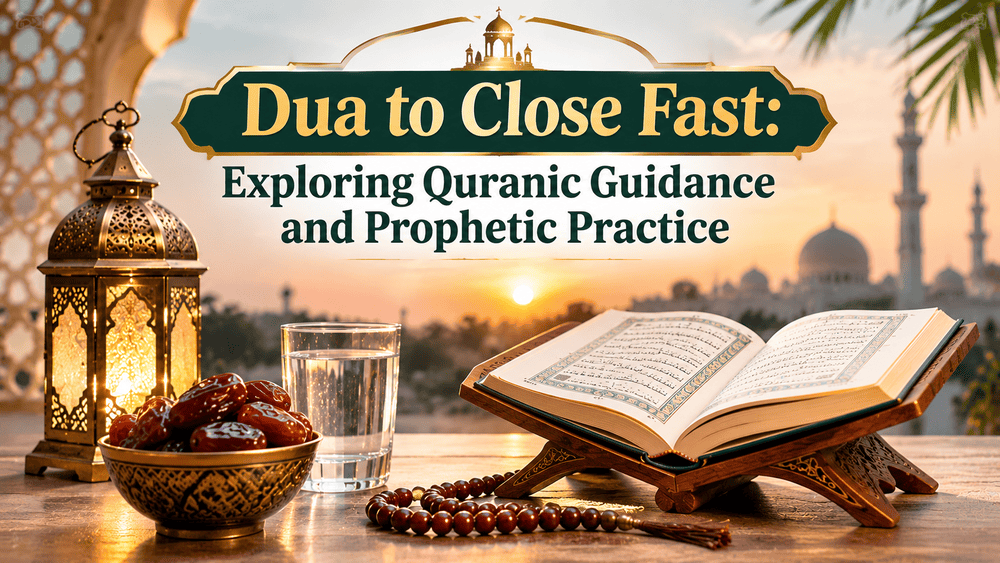
Ramadan fasting is more than avoiding food and drink throughout the day. It involves following Allah's commands, developing self-discipline, and remembering Him during worship. As sunset approaches, many Muslims search for the dua to close fast to understand the correct Iftar supplication and how Prophet Muhammad (ﷺ) broke his fast. The Quran establishes the rules of fasting, while the Sunnah provides practical guidance on Iftar. Knowing both helps Muslims observe Ramadan with confidence and avoid common misunderstandings.
What Does the Quran Teach About Breaking a Fast?
The Quran explains when Muslims should begin and complete their daily fast. In Surah Al-Baqarah, Allah says:
Arabic:
وَكُلُوا وَاشْرَبُوا حَتَّىٰ يَتَبَيَّنَ لَكُمُ الْخَيْطُ الْأَبْيَضُ مِنَ الْخَيْطِ الْأَسْوَدِ مِنَ الْفَجْرِ ۖ ثُمَّ أَتِمُّوا الصِّيَامَ إِلَى اللَّيْلِ
English Translation:
“And eat and drink until the white thread of dawn becomes distinct to you from the black thread [of night]. Then complete the fast until the night.”
Reference: Surah Al-Baqarah (2:187)
This verse establishes the fasting period from true dawn until nightfall. The Sunnah clarifies that Muslims should break their fast when the sun sets, rather than waiting until complete darkness.
Is the Dua for Closing Fast Mentioned in the Quran?
The Quran does not prescribe a specific Arabic supplication that Muslims must recite when breaking their fast.
Instead, the reported dua for closing fast comes from Hadith, which records the teachings and practices of Prophet Muhammad (ﷺ).
This distinction matters because a supplication found in Hadith should not be described as a Quranic verse.
Muslims can also make personal prayers at Iftar, asking Allah for forgiveness, guidance, and blessings.
Authentic Dua to Close Fast in Arabic and English
One supplication reported from Prophet Muhammad (ﷺ) is:
Arabic:
ذَهَبَ الظَّمَأُ وَابْتَلَّتِ الْعُرُوقُ وَثَبَتَ الْأَجْرُ إِنْ شَاءَ اللَّهُ
Transliteration:
Dhahaba az-zama'u wabtallatil-'urooqu wa thabatal-ajru in sha' Allah.
English Translation:
“The thirst has gone, the veins are moistened, and the reward is confirmed, if Allah wills.”
Reference: Sunan Abi Dawud, Hadith 2357. Classified as Hasan by Al-Albani.
This supplication expresses gratitude after completing a day of fasting. Its wording reflects the relief of thirst and the hope of receiving Allah's reward.
Reciting this fast dua is recommended as a Prophetic practice, but it is not a condition for the validity of fasting.
How Did Prophet Muhammad (ﷺ) Break His Fast?
Prophet Muhammad (ﷺ) provided a practical example of how to begin Iftar.
Anas ibn Malik (RA) reported that the Prophet (ﷺ) would break his fast with fresh dates before praying. If fresh dates were unavailable, he would eat dried dates. If neither was available, he would drink water.
Reference: Sunan Abi Dawud, Hadith 2356. Classified as Hasan by Al-Albani.
This narration shows that breaking the fast does not require an elaborate meal.
Muslims can follow this practice when dates are available. However, the absence of dates does not prevent someone from breaking their fast with other permissible food or drink.
Hajj Umrah Planner: Following the Sunnah During Ramadan Travel
Muslims traveling for Umrah during Ramadan may experience unfamiliar schedules, crowded prayer areas, and changes in daily routines. Hajj Umrah Planner encourages pilgrims to prepare for these circumstances while keeping their worship aligned with authentic Islamic guidance.
Pilgrims visiting Makkah or Madinah should follow local Maghrib times and plan their activities around Iftar.
Those performing Tawaf or Sa'i near sunset can consider their physical needs and the time required to reach an appropriate place for breaking the fast.
Travelers should also remember that performing Umrah does not automatically provide an exemption from fasting. Eligibility depends on their actual travel status and applicable Islamic rulings.
Why Does the Sunnah Encourage Breaking the Fast Promptly?
Islam encourages Muslims to break their fast once sunset is confirmed.
Prophet Muhammad (ﷺ) said:
Arabic:
لَا يَزَالُ النَّاسُ بِخَيْرٍ مَا عَجَّلُوا الْفِطْرَ
English Translation:
“The people will remain upon goodness as long as they hasten to break the fast.”
Reference: Sahih al-Bukhari, Hadith 1957; Sahih Muslim, Hadith 1098.
This Hadith emphasizes following the correct Iftar time rather than delaying food and drink unnecessarily.
It also demonstrates that observing the Sunnah involves both supplication and practical actions.
Can Muslims Make Personal Dua at Iftar?
Yes. Muslims can make sincere personal supplications while preparing to break their fast.
They may ask Allah for forgiveness, good health, protection, beneficial knowledge, and guidance for themselves and their families.
Personal prayers can be made in Arabic, English, or another language they understand.
However, Muslims should avoid attributing specific wording or promised rewards to Prophet Muhammad (ﷺ) without reliable evidence.
Common Misunderstandings About Iftar Supplications
Some Muslims believe that reciting a particular Arabic prayer is necessary to complete their fast. This is incorrect.
A fast remains valid even if the person forgets the reported Iftar supplication.
Another misunderstanding is that every commonly shared Ramadan prayer comes directly from the Quran. Islamic sources should be identified accurately before sharing them.
Muslims should also avoid confusing the intention to fast with the supplication recited when breaking it. These are separate matters.
Practical Steps for Breaking Your Fast According to the Sunnah
Following the Prophetic example can make Iftar simple and meaningful.
- Confirm that the sun has set and Maghrib time has begun.
- Break your fast promptly, preferably with dates or water.
- Recite the reported Iftar supplication if remembered.
- Make personal dua and thank Allah for His blessings.
- Perform the Maghrib prayer on time.
- Continue your meal without unnecessary excess.
These steps help Muslims maintain a balance between worship, gratitude, and their physical needs.
Conclusion
The Quran establishes the rules and timing of fasting, while the Sunnah explains how Prophet Muhammad (ﷺ) practiced Iftar. Together, these sources provide Muslims with clear guidance about breaking their fast.
Learning the dua to close fast, understanding its Hadith reference, and following the Prophetic example can help Muslims approach Iftar with greater awareness. The essential practice is to break the fast at the correct time while remembering Allah sincerely.
Frequently Asked Questions (FAQs)
What is the authentic dua to close fast?
One reported supplication begins with Dhahaba az-zama'u wabtallatil-'urooqu, narrated in Sunan Abi Dawud 2357.
Is the Iftar dua mentioned in the Quran?
No. The Quran establishes fasting rules, while the reported Iftar supplication comes from Hadith.
Did Prophet Muhammad (ﷺ) break his fast with dates?
Yes. A narration in Sunan Abi Dawud 2356 describes his practice of breaking the fast with dates or water.
Is reciting the Iftar dua compulsory?
No. Forgetting the supplication does not invalidate the fast.
Can Muslims make personal dua when breaking their fast?
Yes. Muslims may sincerely ask Allah for forgiveness, guidance, and blessings in their own words.