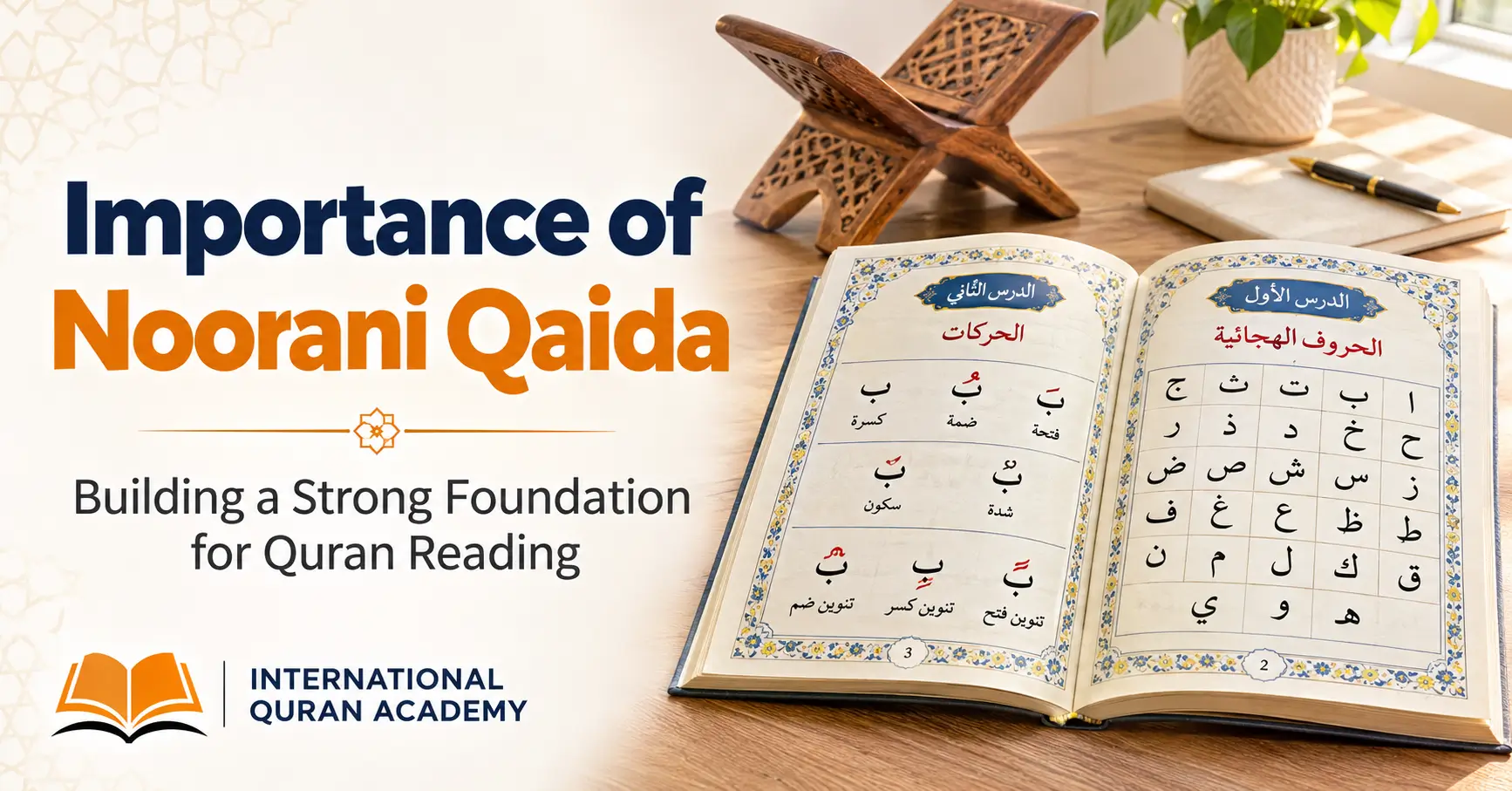
Every meaningful journey begins with learning the basics. For Muslims who want to read the Holy Quran correctly, those basics include recognizing Arabic letters, understanding vowel marks, and pronouncing each sound accurately.
Noorani Qaida provides a structured introduction to these essential reading skills. It helps children, adults, and new Muslims develop the knowledge they need before progressing to complete Quranic verses.
Arabic pronunciation can be challenging for beginners. Several letters look similar, while others require tongue and throat movements unfamiliar to English speakers. Even small differences in vowel length or consonant pronunciation can change the way an Arabic word sounds.
The importance of Noorani Qaida becomes clear when students begin connecting individual letters into words. Rather than memorizing entire passages without understanding their written structure, learners develop practical reading skills they can apply to unfamiliar Quranic text.
At International Quran Academy, foundational Quran education focuses on gradual progress, accurate pronunciation, and individual teacher guidance.
This guide explores how Noorani Qaida works, the essential skills it teaches, its connection with Tajweed, and how beginners can develop lasting Quran reading abilities.
What Is Noorani Qaida in Quran Education?
Noorani Qaida is an introductory Arabic reading textbook commonly used to teach beginners how to read Quranic Arabic.
Its lessons follow a progressive sequence. Students begin with individual Arabic letters and gradually learn connected forms, vowel marks, pronunciation patterns, and basic recitation concepts.
The book is associated with Sheikh Noor Muhammad Haqqani, whose instructional approach became widely used in Quran education across South Asia and beyond.
Unlike a general Arabic language textbook, Noorani Qaida concentrates primarily on reading and pronunciation.
It doesn't provide comprehensive instruction in Arabic conversation, grammar, or Quran interpretation. Instead, it prepares students to recognize and pronounce the written Arabic used in the Holy Quran.
What Makes Noorani Qaida Suitable for Beginners?
Noorani Qaida introduces reading concepts in manageable stages.
Students aren't expected to recognize complex Arabic words immediately. They first learn the individual components that make those words readable.
The learning sequence generally follows this pattern:
Letter recognition → Sound identification → Vowel marks → Connected letters → Word reading → Quranic text
Each stage reinforces previously learned skills.
For example, students who understand the letter ب can learn how its pronunciation changes when different vowel marks appear.
| Arabic Example | Approximate Reading | Learning Concept |
|---|---|---|
| بَ | Ba | Fatha |
| بِ | Bi | Kasra |
| بُ | Bu | Damma |
| بَا | Baa | Long vowel |
| بْ | B with Sukoon | Consonant without a following vowel |
| بَّ | Doubled B with Fatha | Shaddah |
These exercises teach students to interpret Arabic writing rather than depend entirely on memorization.
Why Learning Noorani Qaida Matters Before Quran Recitation
Reading Quranic Arabic requires several abilities working together.
A student must recognize letters, identify vowel marks, combine sounds, and apply appropriate pronunciation rules.
When one of these skills is missing, reading becomes more difficult.
Consider a learner who recognizes every Arabic letter but doesn't understand Shaddah. That student may pronounce doubled consonants incorrectly, even when the letters themselves are familiar.
Similarly, someone who confuses short and long vowels may struggle to maintain accurate Quranic pronunciation.
Noorani Qaida addresses these foundational challenges before students encounter longer passages.
Arabic Letter Recognition Is the Starting Point
Arabic has 28 basic alphabet letters. Several letters share similar shapes and differ mainly through dots.
For example, ب، ت، and ث have related written forms.
Students must recognize the placement and number of dots to identify each letter accurately.
They also need to understand that Arabic letters can change appearance depending on their position within a word.
This knowledge becomes especially useful when students begin reading connected Quranic text.
Correct Pronunciation Protects Reading Accuracy
Arabic contains distinct consonant sounds that learners shouldn't treat as interchangeable.
The letters س and ص, for example, differ in sound characteristics. Similarly, ه and ح have different articulation points.
Traditional Tajweed instruction describes these articulation points as Makharij.
A qualified teacher can demonstrate the correct sounds and identify pronunciation mistakes.
This is particularly important for beginners whose first language doesn't contain equivalent Arabic consonants.
Foundational Learning Supports Future Progress
Students who develop dependable letter recognition and pronunciation skills are better prepared for Quran Nazra.
They can concentrate on reading complete verses rather than repeatedly struggling to identify individual letters.
However, completing Noorani Qaida doesn't eliminate the need for continued instruction.
Quran recitation involves additional Tajweed rules, reading conventions, and practical skills that students develop through further study.
Essential Skills Students Develop Through Noorani Qaida
The benefits of studying Noorani Qaida extend beyond memorizing the Arabic alphabet.
Students develop several connected skills that support accurate reading.
Recognizing Letters in Different Positions
Arabic is generally written in a connected script.
Many letters change their shape depending on whether they appear independently or within a word.
For example, the letter ع appears in different forms:
| Position | Arabic Form |
|---|---|
| Isolated | ع |
| Beginning | عـ |
| Middle | ـعـ |
| End | ـع |
Students learn to identify these forms as representations of the same letter.
This reduces confusion when they encounter unfamiliar Arabic words.
Understanding Harakat and Vowel Sounds
Harakat are vowel marks that help determine how Arabic letters are pronounced.
The three primary short vowels are:
- Fatha (َ): A short a sound.
- Kasra (ِ): A short i sound.
- Damma (ُ): A short u sound.
Students also encounter Tanween, Sukoon, and Shaddah.
Understanding these marks is essential because Arabic pronunciation depends on more than the consonant letters alone.
For instance, كَتَبَ means "he wrote," while كُتِبَ means "it was written."
The consonant letters remain the same, but the vowel marks change the word's pronunciation and grammatical meaning.
Distinguishing Short and Long Vowels
Arabic distinguishes short vowels from long vowels.
Beginners must learn to recognize the written patterns associated with vowel length.
In introductory Tajweed, the natural Madd is commonly taught as a lengthening of two counts.
Other types of Madd follow additional rules that students study later.
A teacher should demonstrate these differences orally because English transliteration cannot reliably represent every detail of Arabic vowel duration.
Applying Sukoon and Shaddah
Sukoon indicates that a consonant has no following vowel.
Shaddah indicates consonant doubling.
Both marks influence the structure and pronunciation of Arabic words.
Students who ignore these marks may add unnecessary vowel sounds or fail to pronounce doubled consonants correctly.
Regular practice helps learners recognize the marks before reading.
Developing Independent Word-Reading Skills
One of the most important learning outcomes is the ability to read unfamiliar Arabic words.
A student may memorize a textbook page without fully understanding how its letters and marks work.
To assess genuine reading ability, teachers can introduce new combinations using previously learned concepts.
When students can read those combinations accurately, they demonstrate that their skills extend beyond memorization.
How Noorani Qaida Introduces Basic Tajweed Rules
Tajweed is the discipline of reciting the Quran with correct articulation and sound characteristics.
Although Noorani Qaida isn't a complete Tajweed course, it introduces concepts that help beginners understand how Arabic pronunciation works.
Makharij: Where Arabic Letters Originate
Makharij refers to the articulation points of Arabic letters.
Traditional Tajweed instruction commonly identifies five general articulation regions:
- Al-Jawf: The oral and throat cavity associated with Madd letters.
- Al-Halq: The throat.
- Al-Lisan: The tongue.
- Ash-Shafatan: The lips.
- Al-Khayshum: The nasal passage associated with Ghunnah.
Understanding these regions helps students appreciate why Arabic letters require different pronunciation techniques.
For example, the letters ب and م both involve the lips, but they differ in how airflow and nasal resonance work.
Students don't need to memorize every technical classification immediately. Their first priority should be producing sounds accurately.
Madd: Learning Proper Vowel Length
Madd involves extending certain vowel sounds according to recitation rules.
The natural Madd, known as Madd Asli, is normally lengthened for two counts.
Students learn to recognize the written patterns that produce long vowels.
A qualified teacher demonstrates the appropriate duration and helps students avoid shortening or unnecessarily extending sounds.
Ghunnah: Understanding Nasal Resonance
Ghunnah is a nasal sound associated with particular Arabic letters and Tajweed rules.
It is especially important when studying Noon and Meem in certain conditions.
Beginners may encounter introductory Ghunnah exercises during foundational lessons.
More detailed applications belong to continued Tajweed study.
Qalqalah: Recognizing a Distinctive Sound
Qalqalah is associated with five Arabic letters:
ق، ط، ب، ج، د
These letters exhibit the characteristic Qalqalah sound when they carry Sukoon, according to the applicable recitation conditions.
Students should learn the sound through teacher demonstrations rather than adding an artificial vowel.
Correct instruction helps distinguish Qalqalah from ordinary vowel pronunciation.
Noorani Qaida for Children, Adults, and New Muslims
Different learners may study the same foundational material for different reasons.
A child might be discovering Arabic letters for the first time. An adult may be returning to Quran education after many years. A new Muslim may be unfamiliar with the Arabic writing system entirely.
Effective instruction should account for these differences.
How Children Benefit From Structured Qaida Lessons
Children often benefit from short explanations, repetition, and visual recognition exercises.
A teacher may introduce a small group of letters before expanding the lesson.
For example, a child learning ب، ت، and ث can practice identifying their dot positions through different examples.
Once the child recognizes these letters consistently, the teacher can introduce additional combinations.
Parents should encourage progress without expecting every child to learn at the same pace.
Why Adult Beginners Can Start at Any Age
Adults sometimes assume that Quran reading must begin during childhood.
However, adults can develop Arabic reading skills through structured instruction and regular practice.
Some adult learners already recognize Arabic letters but struggle with vowel marks. Others need to begin with the alphabet.
A teacher should assess existing knowledge before choosing the starting lesson.
Adults may also benefit from detailed explanations of pronunciation and reading rules.
Supporting New Muslims With Arabic Reading
New Muslims often need instruction that begins with the most basic elements of Arabic writing.
This may include learning that Arabic reads from right to left and that many letters change shape when connected.
Noorani Qaida offers a gradual introduction without requiring previous Arabic knowledge.
Teachers can explain reading concepts in the student's preferred language while demonstrating Arabic pronunciation.
Importantly, reading the Quran and understanding its meaning are separate learning goals. Students may study Quran translation alongside foundational reading instruction.
Common Noorani Qaida Mistakes and How to Correct Them
Learning Arabic reading involves more than repeating lessons. Students need to identify mistakes and understand how to correct them.
| Common Difficulty | Why It Happens | Recommended Approach |
|---|---|---|
| Confusing similar letters | Students overlook dots or connected forms | Practice visual comparisons |
| Incorrect articulation | Arabic sounds differ from familiar language sounds | Practice Makharij with teacher feedback |
| Shortening long vowels | Learners don't recognize Madd patterns | Compare short and long vowel examples |
| Ignoring Shaddah | Students overlook consonant doubling | Identify marks before reading |
| Adding vowels after Sukoon | Learners struggle with consonant combinations | Practice slowly with oral demonstrations |
| Memorizing exercises | Students remember page order instead of reading rules | Introduce unfamiliar combinations |
Why Memorization Alone Isn't Enough
Consider a student who can recite a familiar Qaida page without hesitation.
When the teacher presents the same letters in a different arrangement, the student struggles.
This suggests the learner may have memorized the sequence rather than developed independent reading ability.
A better assessment uses unfamiliar combinations built from previously learned material.
The student must recognize the letters and apply the rules instead of relying on memory.
Why Teachers Should Correct Errors Early
Repeated incorrect pronunciation can become a persistent habit.
For example, a student who regularly pronounces ح like ه may continue making that substitution when reading Quranic verses.
Early correction helps prevent this pattern.
However, correction should remain patient and constructive. Students need opportunities to listen, repeat, and improve without embarrassment.
How Long Does It Take to Learn Noorani Qaida?
There is no universal completion time because students begin with different abilities.
Lesson frequency, home practice, pronunciation difficulties, and teaching methods all influence progress.
The following example illustrates how a beginner's learning plan might develop.
| Learning Stage | Illustrative Duration |
|---|---|
| Letter recognition and pronunciation | 3–4 weeks |
| Connected letters | 2–3 weeks |
| Short vowels and Tanween | 3–4 weeks |
| Long vowels, Sukoon, and Shaddah | 4–6 weeks |
| Reading practice and assessment | 4–6 weeks |
These periods are planning examples, not guaranteed completion times.
Students should advance when they demonstrate sufficient understanding.
A learner who needs additional pronunciation practice may benefit from revisiting earlier lessons rather than moving forward prematurely.
A Practical Daily Revision Routine
A short practice routine can help beginners reinforce their learning.
For example:
- 3 minutes: Review previously learned letters.
- 5 minutes: Practice the current lesson.
- 3 minutes: Read unfamiliar combinations.
- 2 minutes: Review mistakes identified by the teacher.
This 13-minute example can be adjusted to the student's age and concentration.
Consistent, accurate practice is more useful than lengthy sessions filled with repeated mistakes.
Noorani Qaida vs. Quran Nazra: Understanding the Difference
Noorani Qaida and Quran Nazra represent related but distinct stages of Quran education.
Noorani Qaida introduces foundational reading skills.
Quran Nazra involves reading directly from the written Quran.
| Learning Area | Noorani Qaida | Quran Nazra |
|---|---|---|
| Primary focus | Arabic reading fundamentals | Direct Quran reading |
| Starting material | Letters and vowel marks | Quranic words and verses |
| Pronunciation | Foundational articulation practice | Continued application |
| Tajweed | Introductory concepts | Applied recitation rules |
| Learning objective | Develop independent reading skills | Improve Quran reading accuracy and fluency |
When Should Students Begin Quran Nazra?
Teachers should assess reading ability rather than relying only on textbook completion.
A student preparing for Nazra should generally be able to recognize connected letters, read vowel marks, and pronounce unfamiliar words with reasonable accuracy.
Students can continue strengthening pronunciation and Tajweed while reading the Quran.
Some learners may also benefit from additional Qaida revision during the transition.
Can You Learn Noorani Qaida Online?
Yes. Live online Quran lessons allow beginners to study Noorani Qaida with teacher guidance from home.
During a typical class, the teacher introduces the lesson, demonstrates pronunciation, listens to the student, and corrects mistakes.
Online instruction can be particularly useful for families living far from qualified Quran teachers.
Benefits of One-on-One Online Quran Lessons
Individual instruction allows teachers to adapt lessons to each student's needs.
A child struggling with letter recognition may receive additional visual exercises.
An adult needing pronunciation correction can spend more time practicing specific sounds.
Online lessons also offer scheduling flexibility for students living in different countries.
However, educational quality depends on the teacher's knowledge, communication skills, and ability to assess progress.
Can Apps and Videos Replace a Quran Teacher?
Educational apps and videos can help students recognize letters and review familiar lessons.
However, prerecorded material cannot reliably evaluate every pronunciation mistake.
A learner may believe they're producing a difficult Arabic sound correctly without recognizing the difference.
For this reason, self-study resources work best alongside qualified instruction, particularly for beginners.
International Quran Academy also provides a Noorani Qaida PDF with English and Urdu guidance for additional learning and revision.
internationalquranacademy.com
How Parents Can Support Quran Learning at Home
Parents can help children develop consistent learning habits without turning home practice into a stressful activity.
A few practical approaches include:
- Set a regular time for short revision sessions.
- Review the lesson assigned by the teacher.
- Encourage children to identify difficult letters.
- Avoid correcting sounds when you're unsure of their pronunciation.
- Ask the teacher for specific feedback.
- Recognize improvement rather than comparing children.
For example, a child who previously confused similar letters may begin identifying them correctly after focused practice.
Parents should acknowledge that progress even if the child hasn't completed a new lesson.
Positive encouragement helps create a supportive learning environment.
Frequently Asked Questions About Noorani Qaida
Is Noorani Qaida Necessary Before Learning the Quran?
Noorani Qaida isn't the only method of learning Quranic Arabic. However, it provides a structured foundation for beginners who cannot yet recognize letters or vowel marks.
What Is the Best Age to Start Noorani Qaida?
Many children begin introductory lessons around ages four to six. However, readiness depends on attention, interest, and individual development rather than a fixed age.
Can Adults Learn Noorani Qaida Without Arabic Knowledge?
Yes. Adults can begin with the alphabet and progress through vowel marks, connected letters, and word-reading exercises.
Does Noorani Qaida Teach Complete Tajweed?
No. It introduces foundational pronunciation and recitation concepts. Advanced Tajweed requires additional study and practical instruction.
How Many Lessons Are in Noorani Qaida?
A commonly used edition contains 17 lessons, although the number and arrangement can vary between editions.
Can Students Learn Noorani Qaida Without a Teacher?
Students can independently study letter shapes and basic reading marks. However, teacher feedback is especially useful for correcting unfamiliar Arabic sounds.
What Comes After Completing Noorani Qaida?
Most beginners progress to Quran Nazra, where they apply their reading skills to complete Quranic verses.
They may later study advanced Tajweed, Quran memorization, Arabic language, translation, or Tafseer.
Learn Noorani Qaida Online With International Quran Academy
At International Quran Academy, children and adults can learn foundational Quran reading through personalized online instruction.
The academy offers one-on-one lessons with male and female Quran teachers, allowing students to study according to their learning needs and preferred schedules.
Its Noorani Qaida instruction focuses on Arabic letter recognition, pronunciation, vowel marks, connected words, and introductory Tajweed.
Students can attend live classes through platforms such as Zoom, Google Meet, and Microsoft Teams.
Standard beginner Quran lessons generally last 30–35 minutes, with regular opportunities for revision and teacher feedback.
Begin With a Three-Day Free Trial
International Quran Academy offers a three-day free trial for new students.
This allows families and adult learners to experience the teaching approach before choosing ongoing classes.
Students can begin by completing the free Quran class trial registration form.
Conclusion: A Strong Beginning Makes Quran Reading More Accessible
The importance of Noorani Qaida lies in helping beginners develop the essential skills required for accurate Quran reading.
Through structured lessons, students learn Arabic letters, vowel marks, pronunciation principles, and connected word reading.
Children gain a manageable introduction to Arabic literacy. Adults and new Muslims receive a clear starting point, while students with pronunciation difficulties can strengthen specific skills.
Completing the textbook isn't the ultimate objective. The real goal is to develop reading abilities that students can apply independently when approaching Quranic text.
With consistent practice, patient instruction, and accurate feedback, Noorani Qaida can provide a dependable foundation for Quran Nazra and continued Quran education.
Enroll in Noorani Qaida Course
Master the basics of Arabic reading with our Noorani Qaida Course. Perfect for beginners and children, this course covers alphabet recogniti...